
How to Choose a Five Element Bracelet?
Start With Your BaZi, Not the Bracelet
To choose a Five Element Bracelet properly, begin with your BaZi rather than your zodiac sign, favorite color, or a simple list of missing elements. The Day Master provides the starting point, but it is only one part of the judgment. A practitioner should also consider the Month Command, overall strength, seasonal climate, structure, and favorable or unfavorable Five Element relationships before deciding which materials are appropriate. Only then should crystals, colors, engraved elements, or other materials be selected. This approach is different from buying a generic lucky bracelet because the purpose of the combination comes from the individual chart.
That distinction is important because a bracelet that suits one person may be unsuitable for another, even when both people were born in the same zodiac year or share the same Day Master.
If you are deciding how to choose a Five Element Bracelet, think of the process as a consultation followed by a product decision. The bracelet comes last.
What Should You Check Before Choosing a Five Element Bracelet?
The first practical step is to establish what you are actually working with. A birth date can provide the foundation for a BaZi chart, but the interpretation should not stop at identifying one “birth element.”
Traditional BaZi uses the Four Pillars of Year, Month, Day, and Hour. The Day Stem becomes the Day Master, which is the main reference point for understanding the chart. From there, the practitioner looks at how the other Heavenly Stems and Earthly Branches interact with it.
This is where many online interpretations become too simple. They may count how many times Wood, Fire, Earth, Metal, and Water appear and then recommend the element with the lowest number. That can be a useful introductory exercise, but it is not enough for personalized selection.
For a bracelet intended to follow traditional Five Element reasoning, the following factors deserve attention:
| BaZi Factor | What It Tells You | Why It Matters | Common Shortcut | Practical Decision |
|---|---|---|---|---|
| Day Master | The central reference of the chart | Establishes the basic relationship between the person and the other elements | “My Day Master is Fire, so I need Fire.” | Use it as the starting category, not the final prescription |
| Month Command | The seasonal environment of the chart | Season strongly affects the condition of the Day Master and other elements | Ignoring the birth month | Judge elemental needs within the season |
| Strength | Whether the Day Master is relatively strong or weak | Changes the meaning of adding, draining, or controlling elements | Counting visible elements only | Examine relationships, not just quantities |
| 調候 | Cold, heat, dryness, and moisture | Seasonal climate can change which elemental qualities are useful | Treating climate and strength as the same issue | Consider climate separately when selecting materials |
| 喜忌 / 用神 | Which elemental relationships are favorable or unfavorable | Provides the practical direction for personalization | “Missing equals favorable.” | Select materials according to the whole structure |
The order is important. If someone tells you, “You are missing Water, so wear a blue bracelet,” before discussing the rest of the chart, you are not receiving a full personalized judgment.
That does not mean simple Five Element associations have no place. They are useful when translating a traditional conclusion into physical materials. They simply should not be mistaken for the conclusion itself.
Should You Choose a Bracelet Based on Your Birth Date?
A birth date is useful, but “Five Element Bracelet by birth date” can mean two very different things.
In the simplified version, a birth year is assigned to one of the Five Elements and a bracelet is selected accordingly. This is often how a Chinese birth element bracelet is marketed online. The problem is that the Year Pillar alone does not represent the complete BaZi.
In a proper BaZi-based approach, the birth date is used to establish the Four Pillars. If the birth time is available and reliable, the Hour Pillar can also contribute important information. The result is a much more individual chart rather than a general recommendation shared by everyone born in the same year.
There is an important purchasing distinction here: birth information should be used to produce a judgment, not merely a label.
If your only information is “I was born in a Dragon year, so I need Earth,” you have not yet reached the point where a personalized bracelet can be responsibly selected.
For customers who want the traditional framework explained from the chart itself, LuckyAnyway approaches BaZi Analysis as the starting point before moving into physical product selection.
Advice: If a seller asks only for your birth year when offering a supposedly personalized Five Element Bracelet, ask what additional information is being used to determine the combination. A genuine personalized process should have more reasoning behind it than the zodiac animal.
Does Your Day Master Tell You Which Element to Wear?
No. It tells you where to begin.
This is one of the most important points when choosing a BaZi Bracelet. If someone has a Wood Day Master, it does not automatically follow that Wood should be added. The same applies to Fire, Earth, Metal, and Water.
A Day Master can be strong, weak, excessively supported, seasonally affected, or involved in a particular structure. The surrounding elements may generate it, drain it, control it, or alter the conditions in which it operates.
Consider a strong Day Master. The practical direction may be completely different from that of a weak Day Master with the same Heavenly Stem. The label is identical; the judgment is not.
This is why LuckyAnyway can organize its Five Element Collection into five Day Master categories while still treating the final bracelet as a personalized arrangement. The category helps the customer enter the collection. The BaZi determines where the selection goes from there.
How Should the Five Elements Be Translated Into Bracelet Materials?
Once the BaZi direction is established, the next question becomes practical: what should actually be placed on the wrist?
Traditional Five Element associations can be expressed through crystals, stones, colors, engraved elements, and other materials. The choice should make sense both symbolically and within the intended Five Element relationship.
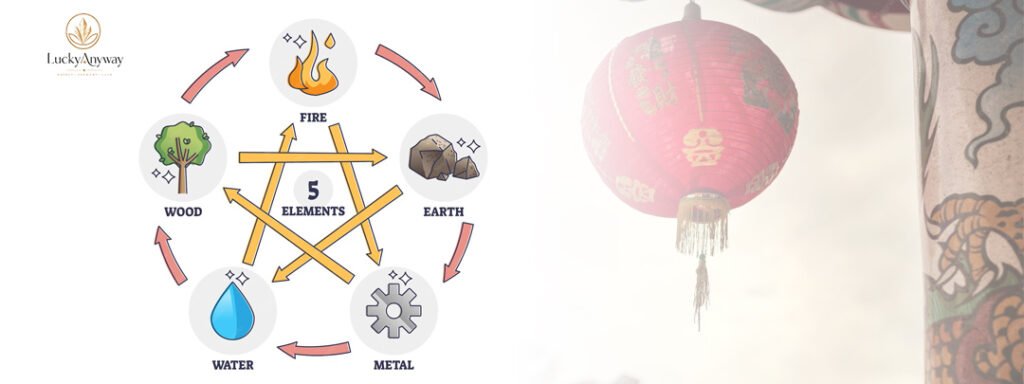
| Element | Traditional Association | Common Material Direction | Useful Quality | Selection Caution |
|---|---|---|---|---|
| Wood | Growth, spring, extension | Green and Wood-associated materials | Development and upward movement | Do not add Wood simply because the chart shows less Wood |
| Fire | Heat, brightness, summer | Red and warm-toned materials | Warmth and illumination | Seasonal heat and 調候 must be considered |
| Earth | Center, stability, transition | Yellow, brown, and Earth-associated materials | Support and containment | Too much Earth can have a very different meaning from useful Earth |
| Metal | Autumn, refinement, firmness | White, metallic, and Metal-associated materials | Distinction and decisiveness | A Metal Day Master does not automatically need more Metal |
| Water | Winter, moisture, depth | Blue, black, and Water-associated materials | Movement and adaptability | Water must be judged within the complete structure |
For a custom crystal bracelet, the final combination may therefore include more than one elemental association. A base material can be combined with a supporting crystal, an engraved crystal connected to a relevant Heavenly Stem or Earthly Branch, or another material selected according to the chart.
The professional question is not “Which crystal is lucky?” It is “What role does this material play in this particular combination?”
Which Five Element Bracelet Should You Choose?
Once you understand the difference between a category and a prescription, the product selection becomes much easier.
The five Day Master categories are useful because they prevent the collection from becoming a confusing wall of unrelated crystals. But they should not encourage customers to make a second mistake: buying the bracelet whose name matches their Day Master and stopping there.
| Your Day Master | Starting Product | What Must Still Be Checked | Possible Personalization | What Not to Assume |
|---|---|---|---|---|
| Wood | Wood Day Master Personalized Crystal Bracelet | Strength, season, structure, favorable elements | Wood-related and supporting materials | That more Wood is automatically beneficial |
| Fire | Fire Day Master Personalized Crystal Bracelet | Strength, seasonal heat, 調候, structure | Fire-related and balancing materials | That Fire is always the preferred addition |
| Earth | Earth Day Master Personalized Crystal Bracelet | Season, dryness or moisture, strength, structure | Earth and contextually suitable supporting elements | That Earth should simply be increased |
| Metal | Metal Day Master Personalized Crystal Bracelet | Strength, Earth support, season, Water and Fire relationships | Metal with selected supporting qualities | That Metal itself is always needed |
| Water | Water Day Master Personalized Crystal Bracelet | Season, strength, Wood, Fire, and Earth relationships | Water with suitable supporting materials | That Water is automatically the correct addition |
This is the practical reason to keep the product categories broad while keeping the actual matching personal. A customer should be able to recognize the correct starting category without being forced into a one-size-fits-all formula.
You can review the Five Element Collection to identify the appropriate Day Master category, then discuss the final combination according to the individual chart.
Advice: Treat the product name as the doorway, not the conclusion. If you are a Metal Day Master, start with the Metal category. Do not assume that the finished bracelet should therefore be dominated by Metal.
When Is a Custom Five Element Bracelet Worth Choosing?
A custom Five Element Bracelet becomes particularly meaningful when you already know that a generic recommendation is not enough for what you are looking for.
For example, you may have received different recommendations from different online calculators. One tells you to wear Water, another says Metal, and a third says your zodiac sign requires a particular color. The problem is not necessarily that every source is useless. The problem is that they may be using different levels of analysis.
A personalized process brings the discussion back to one chart and one reasoning system.
The bracelet can then be developed around the relevant Five Element relationships rather than around a generic promise. Depending on the chart, customization may involve the main crystal, supporting crystal, color arrangement, engraved Heavenly Stem or Earthly Branch, or combinations connected with traditional relationships such as 三合 or 六合.
This is also where the difference between a personalized Five Element Bracelet and a personalized Feng Shui Bracelet becomes useful. The two can overlap in materials and symbolism, but BaZi-based Five Element matching begins from the individual birth chart, while Feng Shui considerations can also involve environmental forms, directions, spaces, and other factors.
For someone who is already interested in Chinese traditional practice, that distinction makes the purchasing conversation much clearer.
Insight: The strongest sign of personalization is not how many different crystals appear in the bracelet. It is whether the maker can explain why each important material was selected and why another material was deliberately left out.
What Should You Ask Before Buying?
A good purchasing conversation should be surprisingly straightforward. You do not need a long list of mystical promises. You need to understand the reasoning.
Ask what BaZi information was used. Ask how the Day Master was assessed. Ask whether Month Command and seasonal conditions were considered. Ask whether the recommendation comes from the complete chart or simply from an element-counting calculator.
Then ask about the physical bracelet: which materials represent which elemental qualities, which material is the main component, which ones provide support, and why the combination was chosen.
A practitioner who has actually made personalized combinations should be able to discuss these decisions clearly. The explanation does not need to be complicated, but it should be internally consistent.
LuckyAnyway approaches this process from the perspective that traditional knowledge should lead the product decision, rather than the product being given a traditional explanation afterward. You can learn more about the brand’s approach through the About Us page.
Frequently Asked Questions
Can I choose a Five Element Bracelet by birth date alone?
Your birth date is the foundation for creating a BaZi chart, but it should not be treated as a one-step bracelet prescription. A proper assessment considers the Four Pillars, Day Master, Month Command, strength, seasonal conditions, structure, and favorable Five Element relationships. A birth year or zodiac sign alone is far too general for true personalization.
Should I wear the element that is missing from my BaZi?
Not necessarily. An element that appears less frequently is not automatically the element that should be added. Traditional BaZi judgment considers what role that element would play within the complete structure. In some charts, an apparently limited element may not be the most suitable direction, while another element may have a more useful function.
What is the difference between a custom Five Element Bracelet and a generic crystal bracelet?
A generic crystal bracelet is usually selected according to appearance, general symbolism, or a broad purpose. A custom Five Element Bracelet begins with an individual BaZi judgment and then translates that judgment into materials, colors, engraved elements, and other physical details. The important difference is the reasoning behind the combination, not simply the number or type of crystals used.
Choose the Reasoning Before You Choose the Bracelet
When people ask how to choose a Five Element Bracelet, they often expect a simple answer: find your birth element, choose the matching color, and buy the corresponding bracelet.
That may be convenient, but it is not the approach to take if you want the bracelet to follow traditional BaZi reasoning.
Start with the Four Pillars. Identify the Day Master. Examine the Month Command and overall strength. Consider 調候, structure, 喜忌, and the relationships among the Five Elements. Only after those questions have been considered should the physical materials be selected.
That process also makes the purchasing decision easier. You do not have to choose between dozens of unrelated “lucky” products. You can identify the appropriate Day Master category, understand the reasoning behind the intended combination, and then decide whether a personalized bracelet is appropriate for you.
A Five Element Bracelet is most meaningful when there is a clear connection between the traditional judgment and the finished object. That is the difference between simply wearing a bracelet associated with the Five Elements and choosing a bracelet with a deliberate traditional basis.
For those who want to explore Chinese traditional practice through a more personal object, LuckyAnyway brings that approach into its Five Element collection, where the product begins with a traditional framework and can be developed according to the individual rather than a generic zodiac recommendation.