
What Gives Us the Strength to Keep Going? A UFC Story About Faith and the Five Elements
What gives a person the strength to keep going when everything becomes difficult? Sometimes it is physical strength. Sometimes it is family. Sometimes it is a memory from childhood. And sometimes, it is faith — the belief that there is still a reason to continue even when the present moment is painful.
A recent UFC fight offers a powerful example of this question.
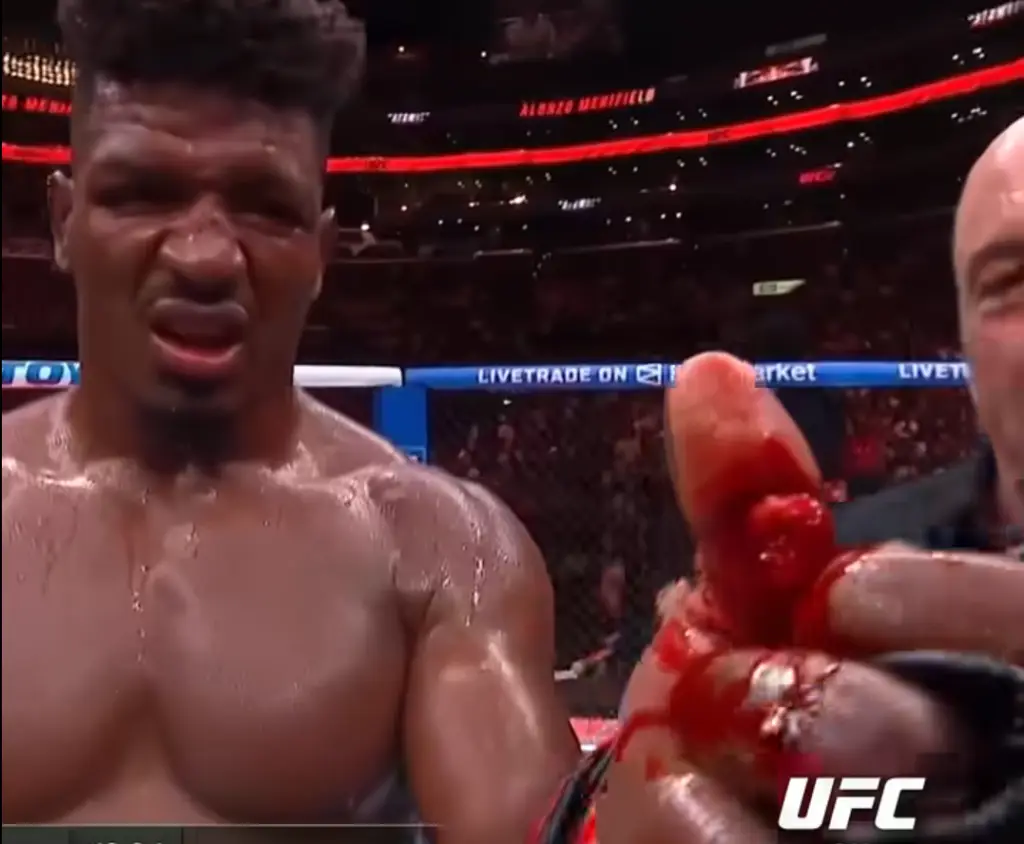
At UFC 331 in Los Angeles, Alonzo Menifield faced undefeated Polish prospect Iwo Baraniewski. During the fight, Menifield suffered a severe compound fracture to his left thumb. After the injury was examined, he continued fighting and eventually won the three-round bout by split decision. UFC officially recorded the result as a victory for Menifield despite the thumb fracture.
But the injury was not the most meaningful part of what happened that night.
It was what Menifield talked about after the fight.
Sometimes the Question Is Not “How Much Can I Take?”
When people watched Menifield continue with a badly injured thumb, the natural reaction was to focus on pain tolerance.
How could he continue?
How could someone look at an injury like that and still step back into the Octagon?
Those are reasonable questions. But there is another question underneath them:
What makes someone believe that continuing is still worth it?
That is a very different question.
Physical strength explains what the body can do. Training explains how a fighter prepares for difficult situations. Experience explains how someone reacts under pressure.
But belief can explain something else: why a person continues when stopping would be understandable.
Menifield’s post-fight comments made that distinction especially interesting. Rather than simply celebrating his toughness, he spoke about where he came from and the experiences that shaped him. MMA Fighting reported that he talked about his mother having to search through trash when he was growing up and connected his present toughness with those earlier experiences.
Suddenly, the broken thumb was no longer the entire story.
It was one moment in a much longer life.
What Menifield’s Story Says About Faith
Faith is often understood only through religion. For many people, that is an essential part of what faith means. But faith can also describe something broader: a deep belief that gives a person direction, purpose, or a reason to keep moving.
For Menifield, his public story has included difficult experiences, family, personal struggle, and a relationship with God. His earlier UFC interviews have also discussed how faith became part of his life during difficult periods.
That makes his latest story particularly interesting.
He did not simply say, “I am tough.”
His explanation pointed backward — toward his childhood, his mother, and the circumstances that helped shape the person he became.
In other words, his strength did not begin inside the Octagon.
The Octagon simply gave people a chance to see it.
This is one of the deeper meanings of faith. It does not necessarily remove hardship. It gives hardship a place within a larger personal story.
A person may still experience pain, uncertainty, disappointment, or fear. Faith does not automatically make those things disappear.
Instead, faith can give someone a reason to keep walking through them.
Why People Need Something to Hold On To
Everyone experiences periods of uncertainty.
Sometimes it is a difficult career decision. Sometimes it is a relationship. Sometimes it is financial pressure, family responsibility, or simply the feeling that life is moving in a direction we do not fully understand.
When people feel lost, they naturally look for something that can give them a sense of connection.
For one person, that may be prayer.
For another, it may be family tradition.
For another, it may be a personal principle that has guided them for years.
For someone connected to Chinese traditional culture, that connection may also come through traditional metaphysical systems such as BaZi, the Five Elements, Feng Shui, or other practices passed down through generations.
These traditions offer people a framework through which they can understand relationships between themselves, their environment, timing, nature, and the patterns of life.
That is why traditional objects can carry meaning far beyond their physical appearance.
A piece of calligraphy, a talisman, a traditional symbol, or a Five Element Bracelet can become part of a person’s relationship with the tradition they believe in.
Where the Five Elements Enter the Story
The Five Elements — Wood, Fire, Earth, Metal, and Water — are fundamental concepts in traditional Chinese philosophy and metaphysical practice.
They are not simply five decorative categories or five colors used to create attractive products.
Within traditional Chinese thought, the Five Elements describe different qualities, movements, relationships, and patterns.
Wood is traditionally associated with growth and benevolence.
Fire is associated with brightness, warmth, and propriety.
Earth is associated with stability, trust, and support.
Metal is associated with righteousness, structure, and firmness.
Water is associated with wisdom, movement, and adaptability.
These associations form only part of a much larger traditional system. In BaZi, the Five Elements are considered within the Four Pillars of Year, Month, Day, and Hour. The Day Master, seasonal influence, strength and weakness, structure, climate adjustment, and favorable or unfavorable relationships can all matter.
This is why traditional Five Element analysis cannot simply be reduced to the question, “Which element am I missing?”
That simplified approach may be easy to understand, but it does not represent the depth of traditional BaZi practice.
A Five Element Bracelet Is More Than a Combination of Beads
This is where a personalized Five Element Bracelet becomes meaningful.
A bracelet can be physically simple: beads, crystals, colors, textures, and a carefully arranged combination.
But the reasoning behind the combination can be much deeper.
For someone who follows traditional Chinese metaphysical principles, a personalized bracelet can represent the relationship between their own BaZi information and the Five Elements.
It can become a personal object connected to their understanding of balance, timing, nature, and traditional principles.
Most importantly, it can become something they consciously choose to carry.
That distinction matters.
We do not need to claim that a bracelet will magically solve every problem in a person’s life. Traditional objects have a different kind of value.
They can give form to something that is otherwise invisible: belief.
A person cannot hold faith in their hands.
But they can wear an object that reminds them of what they believe.
Why Personalization Matters in Five Element Practice
A common modern approach to Five Element products is to identify a missing element and immediately add that element to a bracelet.
Traditional BaZi analysis is more nuanced.
The Four Pillars create a complete structure. The Day Master needs to be considered together with the month, seasonal conditions, overall strength and weakness, structure, climate adjustment, and the relationships among the Five Elements.
Sometimes an element that appears to be lacking is not necessarily the first thing that should be emphasized.
Sometimes an element that appears abundant may play an important role in the overall structure.
This is why the question is not simply:
“What element do I have the least of?”
The more useful traditional question is:
“What does the overall BaZi structure tell us about the role of the Five Elements?”
For people who want to understand that traditional reasoning more deeply, LuckyAnyway approaches personalized bracelets through the broader framework of BaZi rather than a simple element-counting method. You can explore the philosophy behind our work on the LuckyAnyway home page and see how traditional Chinese culture forms the foundation of what we create.
The Bracelet as a Daily Reminder
There is another reason a bracelet can be meaningful: it stays with you.
A book can sit on a shelf.
A piece of advice can disappear from memory.
A thought can become buried beneath the pressure of everyday life.
But something worn on the wrist is encountered repeatedly.
You see it while working.
You see it while traveling.
You see it when making a difficult decision.
You see it during an ordinary morning when nothing particularly dramatic is happening.
That repeated physical presence can turn an object into a personal reminder.
For someone who believes in the Five Elements, the bracelet can remind them of their connection to traditional principles.
For someone going through uncertainty, it can represent the intention to keep moving.
For someone who values Chinese traditional culture, it can be a way of carrying that culture into modern everyday life.
And for someone who sees faith as an important part of life, it can become a quiet personal symbol of what they choose to believe and hold on to.
Faith Does Not Have to Be Loud
One of the things I find most interesting about the Menifield story is that faith does not necessarily look dramatic.
People often imagine faith as something expressed through big statements or public declarations.
But sometimes faith is quiet.
It can be the decision to get up tomorrow morning.
It can be continuing to work toward a goal after a setback.
It can be remembering where you came from.
It can be honoring your family.
It can be following a tradition because it still means something to you.
And sometimes it can simply be wearing something that reminds you:
“I know what I believe, and I know what I am carrying with me.”
From an Octagon to Everyday Life
Alonzo Menifield’s situation was extraordinary. Most people will never step into a UFC Octagon, and nobody should interpret his injury as a reason to ignore serious medical problems or push through an injury without professional evaluation.
The lesson is somewhere else.
His story asks us to think about what lies underneath resilience.
Where does it come from?
What experiences create it?
What beliefs allow someone to continue?
And what gives a person meaning when the future is uncertain?
Those questions are not limited to professional athletes.
They belong to ordinary life.
That is also where traditional culture continues to have a place.
Chinese metaphysical traditions have survived for generations because they give people systems through which they can think about life, relationships, timing, environment, and personal circumstances.
At LuckyAnyway, we believe these traditions should be approached with respect and understanding rather than reduced to fashionable slogans.
Our About Us page explains more about why traditional Chinese culture matters to our work and why we take the principles behind our products seriously.
What Is Your Backbone?
Perhaps the most interesting question to take away from Menifield’s story is not how much pain a person can tolerate.
It is much simpler:
What is your backbone?
What gives you the strength to continue when life does not go according to plan?
For Menifield, his answer is connected to his past, his family, his faith, and the experiences that shaped him.
For someone else, the answer may be completely different.
There is no single form that faith must take.
But people have always searched for ways to make their beliefs part of everyday life.
That is one reason traditional objects continue to matter.
A Five Element Bracelet cannot walk your path for you.
It cannot make every decision on your behalf.
But it can carry meaning.
It can connect a person with a traditional system they respect.
It can serve as a daily reminder of intention and belief.
And when it is personalized through a deeper understanding of BaZi and the Five Elements, it can become something much more personal than a generic accessory.
Wear What Has Meaning
The modern world moves quickly. Trends change quickly. Products appear and disappear quickly.
Traditional beliefs move differently.
They are carried through generations, interpreted through experience, and often connected with the way people understand their own lives.
That is the spirit behind a personalized Five Element Bracelet at LuckyAnyway.
Not simply something attractive to wear.
Not simply a collection of beads chosen because an online chart says an element is missing.
But a personal object connected to traditional Chinese principles and the meaning that those principles hold for the person wearing it.
Perhaps that is the deeper connection between a fighter standing inside an Octagon with an injured hand and someone quietly wearing a bracelet on an ordinary day.
Their circumstances could not be more different.
But both raise the same human question:
When life becomes difficult, what do you believe in enough to keep moving?
For some people, that answer is faith in God.
For others, it is family, tradition, purpose, or a belief in their own path.
For those who find meaning in Chinese traditional culture, the Five Elements can become part of that personal journey.
And a personalized bracelet can become one small, tangible way to carry that meaning with you.
If you want to understand how your own Four Pillars can be considered within this traditional framework, you can learn more through LuckyAnyway’s BaZi Analysis service. It provides the foundation for understanding why personalized Five Element combinations should be considered individually rather than selected from a generic “missing element” chart.
And if you are curious about how a personalized Five Element Bracelet could be considered for your own situation, you can contact LuckyAnyway to discuss your requirements before choosing a personalized combination.
Sometimes what we wear is simply an accessory.
Sometimes, it carries something much deeper.
Faith. Tradition. Intention. And a reminder of what gives us the strength to keep going.