
Water Element Bracelet: Meaning and Feng Shui
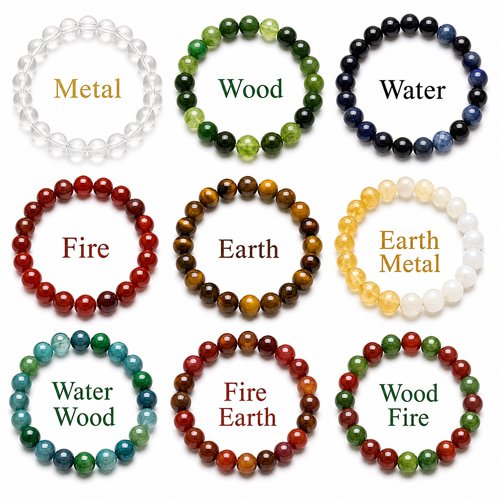
What Is a Water Element Bracelet and What Does It Represent?
A water element bracelet is a traditional Five Elements–inspired personal item designed around the qualities associated with Water: movement, depth, adaptability, storage, communication, and wisdom. In Chinese metaphysical practice, Water is not simply a color or crystal category. Its meaning changes according to the season, the surrounding Five Elements, the condition of a BaZi chart, and whether the bracelet is being considered from a BaZi or Feng Shui perspective.
This is why a water five element bracelet should not be selected simply because someone has been told that Water is “missing.” In professional practice, the more important question is whether Water is actually useful within the person’s overall elemental structure. A cold and overly moist chart may require a very different approach from a hot and dry chart, even when a simple Five Elements count produces the same result.
For this reason, the traditional water element meaning is better understood as a system of relationships rather than a single fixed definition. Water can represent wisdom and depth, but it can also indicate movement, circulation, hidden resources, or excessive coldness depending on the context.
Why Is Water Different From the Other Five Elements?
Water occupies a particularly interesting position in the Five Elements system because it is associated with winter, the North, coldness, storage, and the downward or inward tendency of Qi. Its traditional quality is 智—wisdom. However, this does not mean that every person associated with Water is automatically “wise,” nor does wearing Water automatically create a particular personality.
In the classical Five Elements framework, Water is understood through its relationships. Metal generates Water; Water generates Wood; Water controls Fire; and Earth controls Water. These relationships explain why the same Water influence can have very different consequences in different charts.
For example, Water can nourish Wood and help a Wood Day Master receive Resource energy. Yet if a chart is already excessively cold and wet, additional Water may further strengthen the existing condition rather than solve the underlying imbalance. This is one reason experienced practitioners do not use a simple “less Water means add Water” rule.
The traditional association with Water and 智 also has a deeper meaning. Water is flexible and capable of adapting to its surroundings, yet it can gradually penetrate and move through obstacles. In a practical reading, these qualities can relate to thought, observation, movement, communication, and the ability to respond to changing circumstances.
When LuckyAnyway approaches a Five Element product, the purpose is therefore not to attach a fashionable meaning to a color. The approach begins with the traditional framework and then considers how that framework may be expressed through a personal item.
How Does Water Function in the Five Elements?
The most useful way to understand Water is to look at its position within the complete Five Elements cycle. Water does not exist independently. Its role depends on what generates it, what it generates, what it controls, and what controls it.
| Element | Season | Traditional Quality | Relationship With Water | Practical Reading |
|---|---|---|---|---|
| Wood | Spring | Growth and benevolence | Water generates Wood | Water can provide nourishment and support, but excess may produce excessive Wood. |
| Fire | Summer | Warmth and propriety | Water controls Fire | Water may regulate strong Fire, while excessive Water may suppress necessary warmth. |
| Earth | Transition and storage | Stability and trust | Earth controls Water | Earth can contain or regulate Water, depending on its quality and condition. |
| Metal | Autumn | Structure and righteousness | Metal generates Water | Metal provides the generating relationship behind Water in the productive cycle. |
| Water | Winter | Wisdom, depth and movement | Water generates Wood | Water can indicate movement, storage, adaptability and depth, but its usefulness depends on context. |
This table also shows why a five elements water bracelet cannot be interpreted independently from the other four elements. If Water is added, it does not merely “increase Water.” It also strengthens the relationship between Water and Wood, changes the balance against Fire, and interacts with Earth and Metal.
How Is Water Judged in a BaZi Chart?
In BaZi, Water is judged according to the complete chart rather than by counting how many Water characters appear. The Day Master, Month Command, seasonal climate, overall strength, structural pattern, and useful elements all matter.
This distinction is especially important when someone asks whether they “need Water.” A practitioner should first determine what the Water is supposed to accomplish. Is it needed for 调候? Is it supporting the Day Master? Is it regulating excessive Fire? Is it strengthening an already excessive Water structure? These are different questions and can lead to different conclusions.
调候 and 旺衰 should also be kept separate. 旺衰 examines the strength and distribution of the Day Master and the surrounding Qi. 调候 looks at climate and seasonal conditions. A chart can therefore have a situation where Water appears weak by simple counting but still should not be added freely because the overall climate is already cold and damp.
This is where a personalized water element bracelet differs from a generic Water-themed accessory. A traditional analysis considers what Water is doing in the chart before deciding whether Water-related materials or combinations make sense.
| BaZi Factor | What Is Examined | Why It Matters for Water | Common Mistake | Practitioner’s Question |
|---|---|---|---|---|
| Day Master | The Heavenly Stem of the Day Pillar | Water has a different Ten Gods relationship with each Day Master. | Assuming Water has one universal meaning. | What role does Water play relative to this Day Master? |
| Month Command | Seasonal Qi and the month branch | Season strongly affects Water’s condition and the chart’s climate. | Ignoring season and reading only elemental counts. | Is the chart naturally cold, hot, dry or damp? |
| Strength / Weakness | Support, restraint and overall Day Master condition | The same Water influence can support one structure and burden another. | Treating “more Water” as automatically beneficial. | Will Water correct the structure or reinforce an existing excess? |
| 调候 | Seasonal temperature and moisture | Water may be important for regulating heat or may worsen excessive cold and dampness. | Confusing 调候 with simple 旺衰. | What does the seasonal climate require? |
| 喜忌 / 用神 | Which influences help or hinder the overall structure | This determines whether Water is useful, excessive or conditionally useful. | Choosing Water solely because it is absent. | What problem is Water actually being used to address? |
Does Water Mean the Same Thing for Every Day Master?
No. This is one of the most important distinctions when selecting a Chinese Water Element bracelet through a BaZi-based approach.
For a Wood Day Master, Water belongs to the Resource category because Water generates Wood. For a Fire Day Master, Water represents Officer and Seven Killings energy because Water controls Fire. For an Earth Day Master, Water represents Wealth because Earth controls Water. For a Metal Day Master, Water represents Output because Metal generates Water. For a Water Day Master, Water represents Companion energy.
Therefore, saying “Water represents wealth” without identifying the Day Master is incomplete. That statement applies specifically to an Earth Day Master. The same Water element can represent Resource, Officer/Killing, Wealth, Output, or Companion depending on the Day Master.
This is also why LuckyAnyway’s approach does not begin with a bracelet color and then search backward for a meaning. When personalization is appropriate, the analysis should come first. You can learn more about the approach through the BaZi Analysis service.
What Is the Difference Between Ren Water and Gui Water?
For a more detailed BaZi reading, Water itself should not always be treated as one undifferentiated category. Traditional Chinese metaphysics distinguishes 壬水 and 癸水, the Yang Water and Yin Water Heavenly Stems.
壬水 is often understood through images of large or moving Water—rivers, seas, flowing channels, or broad movement. It has a more expansive and dynamic quality. 癸水, by contrast, is associated with finer Water such as dew, mist, drizzle, or moisture that penetrates gradually. These images are not simply decorative descriptions. They provide a traditional way to understand differences in how Water may function within a chart.
This distinction becomes useful when someone is considering a water crystal bracelet based on a BaZi analysis. A practitioner should not automatically assume that every Water-related material expresses the same quality. The surrounding chart, season, combinations and useful elements still determine what kind of Water influence is appropriate.
In other words, identifying Water is only the beginning. The professional question is how Water operates.
How Should You Choose Water Element Crystal and Jewelry?
A water element crystal or piece of water element jewelry is often designed using colors and materials associated with Water, particularly dark, blue, black, or transparent visual qualities. In modern Five Element product design, materials such as obsidian, lapis lazuli, aquamarine, or clear crystal may be associated with Water depending on the design system being used.
But traditional Five Elements classification should not be reduced to color alone. A blue stone does not automatically become useful Water for every BaZi chart. Material, form, combination, symbolic association, and the person’s overall elemental structure all deserve consideration.
This distinction is particularly important when comparing a commercially labeled water crystal bracelet with a personalized Five Element bracelet. The first may be designed around a general Water theme. The second can be constructed around a specific traditional interpretation of the wearer’s chart.
For someone who simply wants a Water-associated design, a general Water bracelet may be entirely appropriate. For someone seeking a more personalized Five Element arrangement, the selection process should begin with the BaZi structure rather than with the appearance of the stone.
| Concept | Primary Focus | Typical Use | Personalization | Important Distinction |
|---|---|---|---|---|
| Water Element Bracelet | Five Elements relationship | Personal wear and traditional elemental expression | May be personalized through BaZi | Water should be judged within the complete Five Elements structure. |
| Water Feng Shui Bracelet | Water-related Feng Shui symbolism | Personal item associated with Water and Feng Shui traditions | Can reflect personal considerations | It does not replace the assessment of the physical environment. |
| Water Element Jewelry | Design and elemental association | Everyday personal accessory | Usually general rather than chart-specific | Material and color associations do not automatically determine BaZi usefulness. |
| Chinese Water Element Bracelet | Chinese Five Elements tradition | Traditional cultural and personal use | May incorporate BaZi principles | The quality of the interpretation matters more than the label. |
| Water Five Element Bracelet | Water within the Five Elements cycle | Personal elemental matching | Can be highly individualized | “Water” is a relational element, not an isolated category. |
Is a Water Feng Shui Bracelet the Same as Feng Shui Water?
No. This distinction matters because water bracelet feng shui and environmental Feng Shui operate at different levels.
In traditional Feng Shui, Water is considered as part of the physical environment and the movement and gathering of Qi. Depending on the school and method being applied, practitioners may examine landform, orientation, entrances, roads, surrounding structures, waterways, internal circulation and other environmental factors.
A water feng shui bracelet is instead a personal item that expresses Water-related principles or symbolism. It can be meaningful within a person’s personal practice, but it should not be confused with placing or assessing actual Water within a home or business environment.
This is an important professional distinction. If someone has a Feng Shui problem caused by an entrance, external road form, missing corner, unsuitable room arrangement, or another environmental condition, changing a bracelet does not address the physical form itself.
Likewise, someone may use a Water-associated bracelet as part of a personal Five Elements practice while separately examining the Feng Shui of their living environment. The two approaches can complement each other without being treated as the same method.
Should You Wear Water If Your BaZi Is Missing Water?
Not automatically.
This is perhaps the most important practical point when choosing a Chinese water element bracelet. The phrase “missing Water” sounds precise, but a BaZi chart is not a shopping list in which every absent element needs to be added.
For example, a chart may contain relatively little visible Water while still having a structure in which introducing more Water is unnecessary or even counterproductive. Conversely, a chart with several Water characters may still require Water for a specific structural or seasonal purpose.
The same principle applies to other elements. “Missing” and “needed” are not interchangeable terms.
A practitioner therefore looks at the whole chart: the Month Command, Day Master strength, seasonal climate, combinations and transformations, the balance of generating and controlling relationships, and the role of useful and unfavorable elements.
For customers who want a personalized arrangement rather than a general Water-themed bracelet, this distinction should come before choosing the stone. LuckyAnyway’s Five Element Collection follows this broader approach rather than treating elemental matching as a simple missing-element formula.
Insight: Water Is Useful Only When Its Role Is Clear
When choosing a Water-related bracelet, do not begin by asking, “How much Water do I need?” A better traditional question is, “What is Water supposed to do in this chart?” It may nourish Wood, regulate Fire, serve as Resource, Wealth, Output, Officer/Killing, or Companion energy, or contribute to seasonal adjustment. Once that role is understood, material selection becomes much more precise.
What Does a Water Element Bracelet Mean in Everyday Practice?
For many people, a water element bracelet represents qualities traditionally connected with Water: wisdom, flexibility, movement, depth, observation, and the ability to adapt without losing direction.
These qualities can make Water particularly attractive to people who feel they are entering a period of change, movement, learning, travel, communication, or transition. Within Chinese traditional thought, however, the meaning is not separated from balance. Water is powerful precisely because it interacts with everything around it.
This is also why the design of a bracelet can carry more meaning when the components are deliberately combined rather than selected as isolated “Water stones.” A Water-associated crystal may form one part of a broader Five Elements arrangement, while another material may be included because of its relationship with Water or because of a particular BaZi requirement.
For those interested in the cultural background behind this approach, the About Us page explains how LuckyAnyway approaches traditional Chinese concepts and product design.
Frequently Asked Questions About Water Element Bracelets
Is a Water Element Bracelet suitable for everyone?
There is no universal answer. A general Water-themed bracelet can be chosen for its traditional association and design, while a personalized Five Element bracelet should be considered according to the individual’s BaZi structure. If personalization is the goal, the Day Master, Month Command, strength, seasonal climate and useful elements should be examined before deciding whether Water is appropriate.
What crystals are commonly associated with Water?
Modern Five Element jewelry commonly uses dark, blue, black, or transparent stones and crystals when designing Water-associated pieces. Obsidian, lapis lazuli, aquamarine and clear crystal are examples that may appear in contemporary Water-themed designs. However, material color alone does not determine whether Water is useful in a particular BaZi chart.
Is a Water Feng Shui Bracelet the same as a Feng Shui cure for a home?
No. A Water Feng Shui bracelet is a personal item associated with Water-related Feng Shui concepts, while home Feng Shui examines the physical environment, including form, orientation, circulation and surrounding conditions. A personal bracelet and environmental Feng Shui can be considered separately according to their respective purposes.
How Should You Approach a Water Element Bracelet?
A Water Element Bracelet is best understood through the complete Five Elements system rather than through a single color, crystal, zodiac sign, or “missing element” calculation. Traditional Water carries meanings of wisdom, movement, depth, adaptability and storage, but its actual role depends on the structure in which it appears.
For a general Water-themed piece, you may focus on the traditional character and design associated with Water. For a personalized water five element bracelet, the standard should be higher: examine the BaZi chart first, determine the role of Water, and then consider how materials and other elements should be combined.
That distinction is central to a practitioner-led approach. The bracelet is not selected first and justified afterward. The traditional reasoning comes first, and the physical design follows from that reasoning.
To explore the broader collection and how different Five Element approaches are applied to personal bracelets, visit the Five Element Collection.
If you are beginning with the broader Chinese traditional framework, you can also return to the LuckyAnyway home page to explore Five Elements, BaZi, Feng Shui and Chinese talisman traditions together.