
Can You Choose a Five Element Bracelet From Your Birth Date?
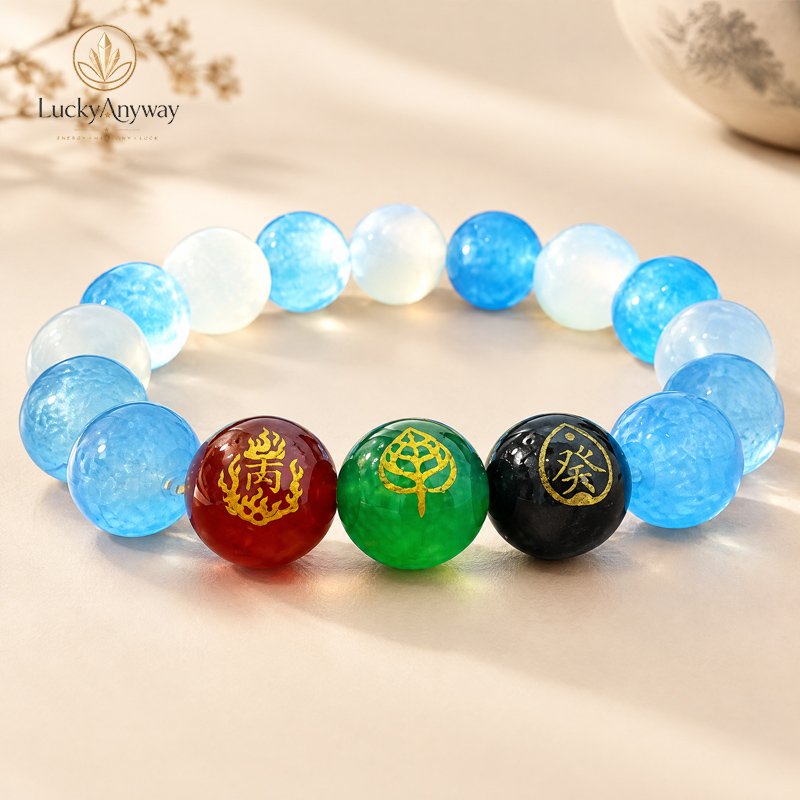
Yes, your birth date can be the starting point for choosing a Five Element Bracelet, but the date alone does not tell you which elements your bracelet should contain. In traditional Chinese metaphysics, a proper birth date five element bracelet is selected through BaZi analysis, which considers the year, month, day, and hour of birth alongside seasonal conditions, the strength and roots of the Day Master, and the structure of the chart. Simply entering a birthday into an online calculator and adding whichever element appears missing can lead to the wrong choice. The important question is not only which elements appear in your birth chart, but how they function together.
Can your birth date tell you which Five Element Bracelet to wear?
Your birth date provides the information from which a traditional BaZi chart can be established. It is a starting point for individualized selection, not a ready-made shopping instruction. A Chinese birth element bracelet should be chosen after the chart has been interpreted, rather than by matching a birth month, a zodiac animal, or a single element to a color.
In BaZi, the four pillars are formed from the year, month, day, and hour. Each pillar contains a Heavenly Stem and an Earthly Branch, creating a more detailed picture than the familiar question, “What is my birth element?” The Day Master—the Heavenly Stem of the day pillar—is an important reference, but it cannot be interpreted in isolation.
Consider two people born in the same year. They may share a zodiac animal, yet their birth months, days, and hours can differ. Those differences may change how the elements interact and what kind of adjustment is appropriate. Even two people with the same Day Master may need different approaches because seasonal conditions, roots, chart structure, and the overall balance are not necessarily alike.
When customers ask LuckyAnyway for a five element bracelet by birth date, the useful next step is therefore to establish whether the available birth information is sufficient for a meaningful reading. A date without a reliable birth time may still offer a starting point, but it does not provide the same level of detail as a complete four-pillar chart. It is better to be clear about that limitation before discussing materials.
Why is adding a missing element not always the right decision?
One of the most common mistakes in choosing a birth element bracelet is assuming that an element absent from a simplified chart must be added through crystals. Traditional BaZi interpretation does not work by filling empty boxes. An element may be absent from the visible Heavenly Stems and Earthly Branches yet still appear in hidden stems or influence the chart through relationships. Conversely, an element that appears several times may already be excessive or may operate in a way that requires careful handling.
The distinction matters because the Five Elements describe relationships and movement, not five separate ingredients that must always be present in equal amounts. Wood, Fire, Earth, Metal, and Water generate, restrain, support, and transform one another. The appropriate choice depends on what the chart needs, not on which category has the smallest count.
| What a simple calculation shows | What it may overlook | Traditional question | Why it matters | Better selection approach |
|---|---|---|---|---|
| An element is not visibly present | Hidden stems and interactions among the pillars | Is this element actually needed? | Absence does not automatically mean deficiency | Interpret the full chart before choosing elemental materials |
| One element appears repeatedly | Season, roots, and the role of that element | Is it useful, excessive, or part of the chart’s structure? | More of a visible element is not automatically better | Choose according to the chart’s actual requirements |
| A zodiac sign is identified | The other three pillars and their relationships | What does the complete BaZi chart indicate? | A zodiac sign is not a complete personal reading | Use the zodiac as cultural context, not the sole selection rule |
| A birth month is matched to a color | Seasonal climate and the chart’s overall configuration | Does the chart require warming, cooling, supporting, or restraining? | The same season does not produce identical charts | Consider seasonal conditions before material and color |
This is why a birth chart bracelet should not be designed from an element-counting result alone. In a traditional reading, the question is how to understand and work with the chart’s relationships. That requires judgment, not simply a calculation.
Which parts of BaZi matter when selecting a bracelet?
A sound selection begins with the chart’s overall conditions. Experienced practitioners do not jump straight from the Day Master to a list of crystals. They first consider seasonal adjustment, then examine the Day Master’s roots, the chart’s structure, strength and weakness, and the specific imbalance that needs to be addressed. These factors work together; none should be treated as a universal shortcut.
Seasonal adjustment (调候) considers whether the chart’s conditions call for warming, cooling, moistening, or drying. It is distinct from the question of whether the Day Master is strong or weak. A chart may require attention to its seasonal conditions even when a basic strength assessment seems straightforward.
Roots (通根) help determine whether an element has a meaningful foundation in the Earthly Branches. A stem that appears prominently on the surface is not always as influential as it first seems; its roots and the surrounding relationships affect how it functions.
Chart structure (格局) helps establish how the chart’s main relationships operate. It prevents a practitioner from treating every chart with the same Day Master as if it had the same needs.
Strength and weakness (旺衰) must be judged in context rather than by counting elements. A strong Day Master does not automatically mean that every element traditionally associated with restraint or support should be added. The chart’s seasonal conditions, roots, structure, and interactions all matter.
Useful adjustment (病药) asks what specific imbalance or difficulty the chart presents and what relationship may help address it. This is a more meaningful basis for choosing a personalized crystal bracelet than trying to make all five elements appear equally represented.
| BaZi factor | What is examined | Common shortcut | More careful judgment | Relevance to bracelet selection |
|---|---|---|---|---|
| 调候 | Seasonal warmth, cold, dryness, and moisture | Choose the color associated with the Day Master | Assess whether seasonal conditions require adjustment first | May affect which elemental qualities deserve priority |
| 通根 | The foundation and support of an element | Count visible appearances only | Consider roots and their strength within the branches | Helps avoid judging an element by surface appearance |
| 格局 | The chart’s organizing relationships | Apply one rule to every person with the same Day Master | Read the chart as a connected structure | Supports a more individual selection plan |
| 旺衰 | The Day Master’s relative strength in context | Assume strong means one fixed set of elements | Combine seasonal, structural, and root analysis | Prevents oversimplified element recommendations |
| 病药 | The chart’s specific imbalance and appropriate response | Add whichever element is least visible | Identify what the chart actually needs to address | Connects the reading to a reasoned material choice |
These distinctions explain why personalized selection takes more care than assigning a crystal color to a birthday. If you want to understand how an individual chart is read before choosing a bracelet, LuckyAnyway’s BaZi Analysis service provides a relevant starting point.
What if you know your birthday but not your exact birth time?
You can still begin exploring a birth date bracelet if your birth time is unknown, but the selection should reflect the information available. In traditional BaZi, the hour pillar is part of the complete chart. Leaving it out means that some relationships and details cannot be assessed in the same way as they can with all four pillars.
Before ordering, check whether your birth time can be confirmed through family records, a birth certificate, or another reliable source. If you were born close to midnight, it is especially important to tell the practitioner the recorded local time rather than casually rounding it. Different charting conventions may also handle the start of a day differently, so the method used should be clear when the birth time is near a boundary.
If the time cannot be recovered, do not let that stop you from asking questions. A practitioner may be able to discuss the available pillars and explain what can reasonably be interpreted. The important distinction is between a preliminary assessment and a complete reading. A responsible recommendation should make that difference clear instead of pretending that missing information has no effect.
For customers seeking a personalized Five Element Bracelet, this is also a practical matter. The goal is not to make the process difficult; it is to avoid presenting a general recommendation as if it were a fully individualized result. Share the birth details you have, clarify what remains uncertain, and ask how that uncertainty affects the proposed selection.
How can you tell whether a bracelet recommendation is genuinely personalized?
A seller does not need to overwhelm you with complicated terminology, but they should be able to explain the reasoning behind the proposed combination. If every person born in a certain year receives the same beads, colors, and elemental formula, the result is closer to a general zodiac product than a bracelet based on an individual BaZi chart.
When discussing a Chinese birth element bracelet, ask what the recommendation is intended to address within the traditional reading. Is the choice based mainly on seasonal adjustment? Does it relate to the Day Master’s roots or the chart’s structure? Has the practitioner considered whether the proposed element is actually appropriate, rather than simply selecting the element that appears least often?
These questions help you distinguish a thoughtful recommendation from a formula that merely sounds personal. A good explanation should connect the chart interpretation to the material choice in plain language. You should understand why the combination was suggested, even if the technical analysis itself is complex.
At LuckyAnyway, the purpose of a personalized approach is to connect traditional Five Element principles with the individual rather than relying on one color, zodiac animal, or universal recipe. You can learn more about the brand’s background and approach on the About Us page.
| What the seller says | What to ask | A reassuring sign | A reason to pause | Your next step |
|---|---|---|---|---|
| “This is your birth element.” | Is this based on my zodiac year, Day Master, or full chart? | The method and limits are explained clearly | The seller treats these different concepts as interchangeable | Clarify the basis before purchasing |
| “You are missing Water, so add Water.” | How was the chart assessed beyond element counting? | The explanation considers relationships and chart conditions | The recommendation depends only on a missing-element result | Ask for the traditional reasoning |
| “Everyone with your Day Master should wear this.” | How do the month, roots, and chart structure affect the choice? | The seller acknowledges differences between charts | One formula is applied to every person | Request an explanation specific to your chart |
| “This bracelet will guarantee wealth or success.” | What does the traditional selection aim to support? | The intended role and limits are described honestly | A guaranteed outcome is used to pressure a purchase | Choose based on sound reasoning, not promises |
Does the crystal color determine whether the bracelet is suitable?
Color is one way traditional Five Element associations are expressed, but color alone cannot establish whether a bracelet is suitable for a particular person. Red is commonly associated with Fire, green with Wood, white with Metal, dark or black tones with Water, and yellow or earthy tones with Earth. These associations can guide the design, but they should follow the interpretation rather than replace it.
The same principle applies to crystal names and materials. A buyer may begin with a preferred stone, a color they enjoy wearing, or a meaningful personal intention. Those preferences can be part of the conversation, but they should not determine the entire elemental formula before the chart has been considered.
When a traditional reading suggests a particular elemental direction, the design can then be developed around suitable materials, bead combinations, and proportions. Some bracelets may use one dominant material with a smaller complementary element; others may call for a more balanced visual arrangement. There is no requirement that every Five Element Bracelet contain five equally represented colors. The arrangement should serve the intended selection, not an arbitrary rule about appearance.
For this reason, a personalized crystal bracelet should be considered as a complete combination. Ask what each main material contributes to the design, how the materials work together within the intended traditional approach, and whether the finished bracelet suits your everyday use. A clear explanation of the selection is more valuable than a long list of crystal names without a reason for including them.
What should you prepare before ordering a Five Element Bracelet based on your birth date?
A little preparation makes a custom order more useful. You do not need to arrive with your own BaZi conclusions or decide in advance which element you should strengthen. In fact, choosing the answer before the chart is assessed can make the conversation less productive. Begin with accurate information and a clear understanding of what you want the traditional selection to help you focus on.
- Provide your birth date and, if known, your birth time. State whether the time is exact, approximate, or unknown.
- Confirm the place of birth if it is requested for chart calculation, especially when local time or time-zone conversion may affect the chart.
- Explain whether you already have a BaZi analysis or need help understanding your chart before selecting materials.
- Mention practical preferences such as wrist size, preferred bead size, and any materials you do not want to wear.
- Ask how the recommended combination follows from the traditional interpretation, rather than requesting a particular element simply because an online calculator says it is missing.
Once you have this information ready, browse the LuckyAnyway Five Element Collection to explore the available personalized bracelet options. The most useful order is one in which the reasoning, material choices, and design are considered together. A beautiful bracelet can be personally meaningful, but for a BaZi bracelet, the individual selection is what distinguishes a custom approach from a generic birth-date product.
Frequently Asked Questions
Can I choose a Five Element Bracelet using only my birth date?
Your birth date is a starting point, but traditional BaZi selection is more detailed than a single-date calculation. The year, month, day, and hour provide different parts of the chart. If your birth time is unknown, a preliminary discussion may still be possible, but the recommendation should reflect the information available rather than claim more certainty than the chart supports.
Is my Chinese zodiac sign enough to choose a birth element bracelet?
No. The zodiac sign is associated with the year pillar, while a full BaZi chart includes four pillars and their relationships. People born under the same zodiac sign can have different chart structures and different considerations for traditional Five Element selection. Zodiac-based products may offer a general cultural association, but they are not the same as an individually interpreted BaZi bracelet.
Should I add the element that is missing from my birth chart?
Not automatically. Traditional interpretation considers the role, strength, roots, and relationships of the elements, as well as seasonal conditions and chart structure. An element that appears absent in a simplified calculation is not necessarily the element that should be added. A more reliable choice begins with understanding what the chart calls for, then selecting materials and colors accordingly.
Choose from your chart, not from a shortcut
A birth date five element bracelet can be a meaningful way to bring traditional Chinese metaphysical principles into daily life, provided the selection is approached with care. The birthday supplies the starting information; it does not, by itself, decide the bracelet’s elemental composition. A sound approach considers the full BaZi chart where possible, distinguishes seasonal adjustment from strength and weakness, and identifies the chart’s actual requirements before choosing materials.
When comparing a birth date bracelet with a genuinely personalized option, look beyond the color, zodiac sign, or number of elements listed on a product page. Ask how the recommendation was reached and whether the explanation accounts for your individual chart. This is the difference between following a general birthday formula and using traditional knowledge to make a considered personal choice.
At LuckyAnyway, the Five Element approach is rooted in the traditional relationship between BaZi interpretation and individual selection. Take time to understand the reasoning, provide the most accurate birth details available, and choose a bracelet whose materials and design follow a clear purpose rather than a shortcut.