
The Twelve Earthly Branches Explained: Their Five Elements and Meanings
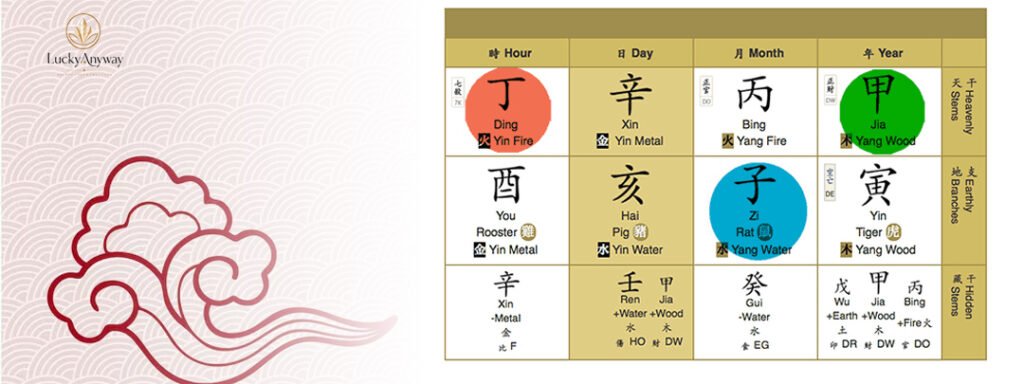
Understanding the Twelve Earthly Branches in Traditional BaZi
The Twelve Earthly Branches are not simply the twelve Chinese zodiac animals. In traditional BaZi, they represent a deeper system of time, seasons, and elemental relationships. A person born in the Year of the Rabbit is not automatically a “Wood person.” Professional BaZi analysis examines the complete Four Pillars to understand how each Branch interacts with the entire chart.
For those exploring Five Elements, this distinction is essential. The zodiac animals are a cultural symbol derived from the Earthly Branches, but the Branches themselves are part of a much more detailed framework used to evaluate elemental strength, seasonal influence, and the structure of a BaZi chart.
What Are the Twelve Earthly Branches in BaZi?
In BaZi, the Four Pillars are built from two components: the Ten Heavenly Stems and the Twelve Earthly Branches. Each pillar contains one Stem above and one Branch below, creating a relationship between visible expression and underlying elemental conditions.
The Heavenly Stems describe the outward qualities of the Five Elements, while the Earthly Branches represent the environment where those energies exist. This is why traditional practitioners pay close attention to the Branches when analysing seasonal strength, especially the Month Branch, which represents the seasonal energy at the time of birth.
A simple way to understand this difference is:
| System | Main Function | Traditional Understanding |
|---|---|---|
| Heavenly Stems | Represent visible elemental qualities | The expression and nature of elemental energy |
| Earthly Branches | Represent hidden conditions and seasonal environment | The foundation where elemental energy develops |
| Chinese Zodiac | A cultural symbol based on the Year Branch | A simplified public representation |
Insight — The Earthly Branch is not a personality label.
Many modern interpretations reduce the zodiac animal into a fixed personality description. Traditional BaZi takes a different approach: a Branch is evaluated by its position, season, hidden elements, and interaction with the entire chart.
Why Are Earthly Branches Not the Same as Chinese Zodiac Signs?
This is one of the most common misunderstandings among people first learning about Chinese metaphysics.
The twelve zodiac animals are connected with the Twelve Earthly Branches, but they represent only one public-facing layer of the system. In traditional BaZi, the Branch itself carries much more information than the animal symbol.
For example, someone born in the Year of the Rabbit is associated with the Branch Mao (卯). Mao belongs to Wood in the Five Elements system. However, this does not mean the person automatically needs more Wood energy, has a Wood-dominant chart, or should choose Wood-related items.
The reason is that BaZi analysis considers the complete structure:
- The Day Master and its condition.
- The Month Branch and seasonal strength.
- The hidden elements contained within each Branch.
- The relationships between Stems and Branches.
This is why traditional practitioners do not determine Five Element balance from the zodiac sign alone.
Advice — Avoid choosing elemental products based only on your zodiac animal.
A zodiac sign provides cultural meaning, but personalized Five Element guidance requires understanding the complete BaZi structure.
How Do the Twelve Earthly Branches Relate to the Five Elements?
Each Earthly Branch carries a primary elemental nature, but some Branches contain additional hidden elements. These hidden elements explain why Branches cannot always be interpreted in a simple one-to-one way.
The Twelve Branches are traditionally grouped according to their elemental tendencies and seasonal positions:
| Earthly Branch | Zodiac Symbol | Main Element | Main Qi | Traditional Meaning |
|---|---|---|---|---|
| Zi (子) | Rat | Water | Gui Water | Beginning of hidden movement and storage |
| Chou (丑) | Ox | Earth | Ji Earth | Storage and transition between seasons |
| Yin (寅) | Tiger | Wood | Jia Wood | Growth and rising movement |
| Mao (卯) | Rabbit | Wood | Yi Wood | Expansion and flexibility |
The remaining eight Earthly Branches will continue in Part 2, including their hidden elements, Branch relationships, and why professional BaZi interpretation requires looking beyond individual symbols.
What Are the Remaining Earthly Branches and Their Hidden Elements?
The Twelve Earthly Branches form a complete cycle representing different stages of seasonal energy. While each Branch has a primary elemental association, some contain additional hidden elements known as Hidden Qi. These hidden elements explain why a Branch cannot be interpreted only by its visible Five Element category.
In traditional BaZi practice, the Main Qi represents the dominant quality of a Branch, while the hidden elements provide additional information about its internal structure. However, these hidden elements must always be considered within the entire Four Pillars rather than interpreted independently.
| Earthly Branch | Zodiac Symbol | Main Element | Main Qi | Hidden Qi |
|---|---|---|---|---|
| Chen (辰) | Dragon | Earth | Wu Earth | Yi Wood, Gui Water |
| Si (巳) | Snake | Fire | Bing Fire | Wu Earth, Geng Metal |
| Wu (午) | Horse | Fire | Ding Fire | Ji Earth |
| Wei (未) | Goat | Earth | Ji Earth | Yi Wood, Ding Fire |
| Shen (申) | Monkey | Metal | Geng Metal | Ren Water, Wu Earth |
| You (酉) | Rooster | Metal | Xin Metal | — |
| Xu (戌) | Dog | Earth | Wu Earth | Xin Metal, Ding Fire |
| Hai (亥) | Pig | Water | Ren Water | Jia Wood |
Insight — Hidden Qi explains why simple Five Element labels are incomplete.
A Branch may appear to belong to one element, but its internal composition creates a more complex interaction. This is one reason traditional BaZi analysis cannot be reduced to “your zodiac sign equals your element.”
Why Is the Month Branch Important in BaZi Analysis?
Among the Twelve Earthly Branches, the Month Branch holds a particularly important position because it represents the seasonal environment at the time of birth.
Traditional BaZi theory emphasizes that timing affects elemental strength. The same Heavenly Stem or Branch may behave differently depending on whether it appears during spring, summer, autumn, or winter.
For example, Wood energy naturally receives seasonal support during spring, while Fire becomes stronger during summer. This does not mean one season is automatically better than another. Instead, it describes the environment in which the Five Elements operate.
This is why professional practitioners first examine the relationship between the Day Master and the Month Branch before making conclusions about strength, balance, or favorable elements.
How Do Earthly Branch Relationships Work in BaZi?
The Twelve Earthly Branches do not exist independently. They interact with each other through several traditional relationships, including combinations and clashes.
Six Harmonies (六合)
The Six Harmonies describe a relationship of connection and attraction between certain Branches. In traditional interpretation, this can indicate a tendency for energies to cooperate or combine.
However, a combination is not automatically good or bad. The final effect depends on whether the resulting energy supports or challenges the overall chart.
Three Harmonies (三合)
Three Harmonies describe groups of Branches that can create a stronger elemental tendency when conditions are present. They show how different Branches may gather and reinforce a particular elemental direction.
Clashes (冲)
Clashes describe opposing movements between Branches. They do not simply mean disaster or bad luck. In traditional BaZi, movement and change can sometimes create opportunities depending on the structure of the chart.
Advice — Do not interpret Branch relationships separately from the whole chart.
A clash, combination, or interaction only shows a relationship between energies. Whether it becomes supportive or challenging requires examining the complete Four Pillars.
Can You Choose Five Element Products Based on Your Zodiac Sign?
A common question among people interested in Five Element accessories is whether they should choose products according to their Chinese zodiac animal.
Traditional BaZi does not make recommendations this way. The zodiac sign represents only one Branch, usually connected with the Year Pillar. It does not reveal the complete elemental balance of a person’s chart.
A more complete evaluation considers the relationship between the Day Master, seasonal strength, supporting elements, and the role of each Branch within the entire structure.
This principle is why LuckyAnyway approaches Five Element understanding through traditional BaZi methods rather than simplified zodiac categories.
To explore your own elemental structure, you can begin with a complete BaZi Analysis that evaluates your Four Pillars.
Frequently Asked Questions About the Twelve Earthly Branches
Are the Twelve Earthly Branches the same as Chinese Zodiac signs?
No. The zodiac animals are symbolic representations of the Twelve Earthly Branches. In BaZi, the Branches contain deeper information about Five Elements, seasons, and hidden energies.
Does my zodiac animal determine my Five Element?
No. Your zodiac animal is only one part of your Four Pillars. Traditional analysis requires looking at the complete BaZi chart.
Why are hidden elements important in Earthly Branches?
Hidden elements reveal the internal structure of a Branch. They help practitioners understand why elemental interactions are more complex than visible symbols alone.
Can Earthly Branches show whether an element is favorable?
A Branch provides important information, but favorable elements are determined through the complete BaZi structure, including strength, season, and overall balance.
Understanding Earthly Branches Through Traditional BaZi
The Twelve Earthly Branches are the foundation that connects time, seasons, and elemental relationships in BaZi. They are far more than zodiac symbols used for general fortune explanations.
A deeper understanding of Earthly Branches helps explain why traditional Five Element analysis requires a complete view of the Four Pillars rather than a single sign, element, or assumption.
You can learn more about LuckyAnyway’s traditional approach and philosophy through our About Us page.
For questions about our approach or traditional Five Element guidance, please feel free to contact us .