Beneil Dariush: How Faith, Family, and Cultural Roots Shape a Fighter’s Life
When Faith and Heritage Become Part of a Life
Faith does not always begin with a personal crisis. Sometimes it is carried through family, language, community, and the traditions a child grows up seeing every day. UFC fighter Beneil Dariush offers a powerful example. Born in Iran to an Assyrian Christian family and brought to the United States as a child, he has spoken openly about how his background and faith have shaped his life. His journey into elite mixed martial arts is not simply a story of sporting ambition. It also raises a larger question: what happens when a person carries the beliefs and identity of one generation into a very different world?Who Is Beneil Dariush Beyond the UFC Octagon?
Beneil Dariush is known as a skilled mixed martial artist who has competed among the leading fighters in the UFC lightweight division. But to understand the person behind the athlete, it helps to look further back than his professional record. Dariush was born in Iran and grew up in a Christian Assyrian family. His early life included time in a small village and work on his family’s farm. When he was around nine years old, his family moved to the United States. The move offered a different future, but it also meant growing up between cultures, adapting to a new country, and building a life beyond the place where his earliest memories had formed. The Assyrians are an ancient people with a distinctive cultural and linguistic heritage, and Christianity has played a significant role in many Assyrian communities. For families who carry this identity across generations and national borders, heritage is not just a detail on a biography. It can shape the stories told at home, the community a person belongs to, the holidays observed, and the values that guide everyday decisions. Dariush has discussed the challenges of being part of a Christian minority in Iran. He has also described his family’s decision to move to America in the context of their concerns about the future. His story should not be reduced to a simple tale of escape or hardship: he has recalled positive memories of his childhood village, while also acknowledging the wider difficulties his family considered when deciding to leave. That complexity matters. A person’s background is rarely one thing. Affection for a childhood home, loyalty to family, awareness of religious identity, and the desire for opportunity can all exist together.How Did Family and Faith Influence His Journey?
For Dariush, Christianity has remained a visible part of his public identity. He has spoken about his belief in God in interviews and around his fights, including when discussing the emotional demands of competition. His faith is not simply a label attached to his name; it is part of how he explains his values and the person he wants to become. Professional fighting is an unusual setting in which to consider faith. The sport rewards aggression, competitiveness, and a willingness to impose one’s will on another athlete. Yet Dariush has described the effort required to control his instincts and act with kindness outside the cage. In a 2026 interview with UFC.com, he reflected on the tension between his natural drive to fight and the discipline he associates with being a Christian. That distinction is worth noticing. Values are not always effortless simply because someone believes in them. A person may inherit a faith, accept its teachings, and still need to work every day to live by them. In that sense, belief is both an identity and a practice. Family can help sustain that practice. It provides continuity when work, public attention, and competition pull a person in different directions. It can also remind someone that an athlete’s value is not measured only by wins and losses. This is one reason Dariush’s story resonates beyond MMA fans. People often look for meaning in the lives of public figures, but the more useful lesson is not that faith automatically produces success. It is that a set of deeply held values can continue to shape a person’s choices while their circumstances change.Why Does Cultural Identity Often Outlast a Change of Country?
Moving to a new country changes the environment around a family, but it does not necessarily erase what the family carries with it. Language, food, religious practice, family stories, and shared customs can remain important long after the journey itself is over. For a child who grows up between cultures, identity may become layered rather than divided. A person can participate fully in American life while maintaining a connection to Assyrian roots and Christian faith. These parts of identity do not need to compete for a single place in the person’s life. There is a practical lesson here for anyone trying to understand their own background. Cultural inheritance is not only about preserving the past exactly as it was. It is also about deciding which values, practices, and relationships remain meaningful in the present. That requires more than repeating a tradition because previous generations followed it. It involves learning what the tradition means, understanding the circumstances in which it developed, and choosing how to carry it forward. This is a useful way to think about inherited beliefs more generally. Some people receive a religious tradition from their parents. Others grow up around cultural customs, seasonal observances, or family practices that they understand more fully only as adults. In both cases, meaning can deepen over time as experience gives old teachings a new context. For Dariush, his career has placed him before an international audience, but his public identity still includes the family and faith that came before his success. The story is not only about reaching a new destination. It is also about what a person continues to carry along the way.What Can Chinese Tradition Teach Us About Inherited Beliefs?
Chinese culture has its own long-standing ways of understanding life, family, timing, nature, and personal circumstances. BaZi, the Five Elements, and Feng Shui developed within different historical and philosophical traditions from Christianity. They should not be treated as alternative names for the same belief system. Yet there is a meaningful point of connection: people often turn to inherited traditions to understand their place in the world and to decide how they want to live. In Chinese families, traditional knowledge may be passed down through festivals, household customs, advice from elders, choices about a home, or the practice of examining a person’s BaZi. Some people encounter these traditions in childhood; others become interested later, when facing a major decision or trying to understand a difficult stage of life. The important question is whether a tradition is understood deeply enough to be applied well. Repeating a familiar phrase is not the same as understanding its original context. Wearing a color associated with an element is not the same as interpreting a complete BaZi chart. Placing an object in a particular area of a home is not the same as examining the home’s actual layout and surrounding environment. Experienced practitioners pay attention to these distinctions because a traditional method is only as useful as the judgment behind its application.How Does BaZi Differ from a Simple Personality Reading?
BaZi, often called the Four Pillars of Destiny, uses a person’s birth year, month, day, and hour to construct a chart based on the traditional Chinese calendrical system. Its Heavenly Stems and Earthly Branches form a network of relationships interpreted through established principles. A common mistake is to reduce this process to a quick personality description or a count of the Five Elements. The chart is more complex than that. A practitioner considers the seasonal setting, the Day Master, roots, chart structure, relative strength, and the interaction of elements. Climate adjustment, known as 调候, can also be crucial: a chart’s temperature and moisture conditions are not the same question as its overall strength. That difference matters in real consultations. Two people can share the same Day Master but have different chart structures and different needs. Likewise, an element that appears infrequently is not automatically the element that should be added. A decision based on one isolated feature may miss the relationships that determine its meaning. BaZi is traditionally used to examine patterns, tendencies, and timing. It should not be treated as a sentence that removes personal responsibility. Understanding a chart can inform reflection and planning, but it does not eliminate the need to make choices, develop skills, maintain relationships, or respond to changing circumstances. For readers who want to explore their own chart in greater depth, LuckyAnyway’s BaZi Analysis service provides a starting point for understanding the traditional framework rather than relying solely on simplified online interpretations.How Should You Choose a Five Element Practice Without Following Internet Myths?
The Five Elements—Wood, Fire, Earth, Metal, and Water—are often introduced through familiar associations with colors, directions, seasons, and materials. These associations can be useful as a first step, but they are not a complete decision-making method. In BaZi-based selection, the relevant question is not simply which element is absent. It is which element and relationship make sense within the chart’s overall configuration and the purpose of the practice. In Feng Shui, the question may instead concern the actual environment, the arrangement of a space, and the method being applied. A talisman belongs to its own tradition of use and interpretation; it should not be treated as interchangeable with a crystal bracelet or a home adjustment. Here is a practical way to distinguish a considered traditional approach from a shortcut.| Tradition | What People Often Want | What Needs Examination | Common Mistake | Better Starting Point |
|---|---|---|---|---|
| BaZi | Understand personal tendencies and timing | Four Pillars, season, Day Master, roots, structure, and element relationships | Using a single chart label as a complete verdict | Seek an interpretation that explains how the chart’s factors interact |
| Five Elements | Choose a suitable personal accessory | The intended element correspondence and the reasoning behind the selection | Adding whatever element appears to be missing | Understand the chart before choosing a personalized combination |
| Feng Shui | Improve the experience and arrangement of a home | Layout, orientation, surrounding forms, and the relevant school of practice | Applying a generic placement rule to every home | Start with the actual environment rather than a universal formula |
| Chinese talismans | Maintain a connection with a traditional blessing practice | The talisman’s cultural background, intended use, and customary handling | Treating every talisman as identical or interchangeable | Learn what the particular tradition and item represent |
| Family customs | Preserve a meaningful connection across generations | The custom’s origins, context, and place in contemporary life | Assuming that repetition alone guarantees understanding | Learn the meaning and decide how to carry the practice forward |
Can a Traditional Object Have a Place in Modern Life?
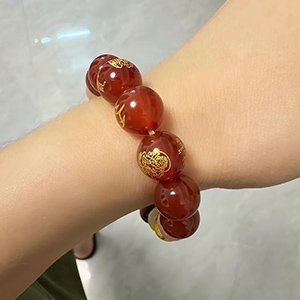
Yes. A traditional object can connect a person with a cultural practice, a family memory, or a personal intention while fitting naturally into modern life. Its meaning depends in part on the tradition it belongs to and how the person chooses to engage with it. This is relevant to people who wear Five Element crystal bracelets. Some are interested in BaZi and want a design selected in accordance with a considered chart interpretation. Others are drawn to Chinese culture and want to learn more about the traditional associations of the materials and elements. Those interests can overlap, but they should not be assumed to be identical. At LuckyAnyway’s Five Element Collection, the focus is on personalized designs informed by Chinese Five Element and BaZi principles, rather than choosing a bracelet solely by a favorite color or a missing-element result from a quick online calculator. If you are considering a personalized piece, a useful first step is to explain what you hope to explore and ask how the proposed combination was selected. A thoughtful purchasing conversation should make the reasoning understandable. You should be able to learn why the elements and materials were considered appropriate, rather than being asked to accept a recommendation without explanation. You can learn more about LuckyAnyway’s approach and its connection with Chinese traditional culture on the About Us page. The aim is to make traditional knowledge more accessible while respecting the distinctions between different practices.Frequently Asked Questions
Does faith have to begin with a difficult experience?
No. As Dariush’s story illustrates, faith can be part of a person’s life through family, community, and cultural inheritance long before a major crisis occurs. A person may later develop a deeper personal understanding of that faith as life changes. Other people discover a tradition as adults. There is no single path by which inherited beliefs become personally meaningful.Are BaZi and Christianity describing the same kind of belief?
No. Christianity is a religion centered on its own theological beliefs and practices. BaZi is a traditional Chinese system that interprets a person’s birth chart through the Four Pillars and their relationships. They have distinct origins, methods, and purposes. A comparison can help us discuss how people relate to inherited traditions, but it should not erase the differences between them.How do I know whether a Five Element bracelet is suitable for me?
Begin by deciding whether you want a culturally informed accessory or a personalized selection based on BaZi. If you want the latter, do not rely on color, zodiac sign, or a missing-element count alone. Ask how the complete chart was interpreted and how that interpretation informs the proposed combination. A considered choice should have a clear traditional rationale and fit what you are looking for.What We Carry Forward Matters
Beneil Dariush’s life offers a perspective that goes beyond the familiar sports story of a fighter pursuing success. His Iranian childhood, Assyrian heritage, family history, and Christian faith remain part of how he describes himself, even as his career has taken him onto one of the world’s biggest sporting stages. That is the deeper connection with Chinese traditional culture. People do not always seek traditions because they have lost their way. Sometimes they seek to understand something that has been present in their families and communities for generations. At other times, a new stage of life encourages them to revisit what they inherited and decide how to apply it. BaZi, the Five Elements, Feng Shui, and Chinese talisman traditions each offer their own ways of approaching particular questions. They are not interchangeable, and none should be reduced to a collection of quick online rules. Understanding their differences is part of respecting them. For some people, faith provides the foundation on which they build their lives. For others, cultural traditions offer a way to think about timing, family, nature, and personal circumstances. What matters is approaching those traditions with understanding rather than assumption. At LuckyAnyway, that respect for traditional knowledge is central to the way we discuss Chinese metaphysical culture and personalized Five Element products. The goal is not to make every tradition say the same thing. It is to help people understand the practice they are drawn to, make more considered choices, and carry what matters to them into everyday life.Contact Us
Similar Posts
What Are the Five Elements in Chinese Philosophy? A Beginner’s Guide
The Five Elements in Chinese philosophy are Wood, Fire, Earth, Metal, and Water. They are not simply five physical materials, five personality types, or five modern “energy categories.” In traditional Chinese thought, they describe different qualities of movement, transformation, relationship, and seasonal change. They are also associated with the Five Virtues—benevolence, propriety, trustworthiness, righteousness, and…
What Is a Five Element Bracelet?
Understanding the Traditional Meaning of Five Element Jewelry A five element bracelet is a piece of jewelry designed around the traditional Chinese system of Wood, Fire, Earth, Metal, and Water. It may use crystals, colors, natural materials, or symbolic elements associated with these five phases. In traditional Chinese practice, the Five Elements are not simply…
Can You Choose a Five Element Bracelet From Your Birth Date?
Yes, your birth date can be the starting point for choosing a Five Element Bracelet, but the date alone does not tell you which elements your bracelet should contain. In traditional Chinese metaphysics, a proper birth date five element bracelet is selected through BaZi analysis, which considers the year, month, day, and hour of birth…
How to Choose a Five Element Bracelet?
Start With Your BaZi, Not the Bracelet To choose a Five Element Bracelet properly, begin with your BaZi rather than your zodiac sign, favorite color, or a simple list of missing elements. The Day Master provides the starting point, but it is only one part of the judgment. A practitioner should also consider the Month…
Feng Shui Bracelets for Good Fortune and Prosperity
A Feng Shui prosperity bracelet is traditionally used as a wearable symbol to support intentions related to fortune, abundance, and harmonious energy flow. In Chinese cultural practice, prosperity is not viewed only as gaining wealth, but as creating a balanced relationship between personal qualities, timing, environment, and opportunities. A properly selected bracelet may represent these…
Water Element Bracelet: Meaning and Feng Shui
What Is a Water Element Bracelet and What Does It Represent? A water element bracelet is a traditional Five Elements–inspired personal item designed around the qualities associated with Water: movement, depth, adaptability, storage, communication, and wisdom. In Chinese metaphysical practice, Water is not simply a color or crystal category. Its meaning changes according to the…