
What Are the Five Elements in Chinese Philosophy? A Beginner’s Guide
The Five Elements in Chinese philosophy are Wood, Fire, Earth, Metal, and Water. They are not simply five physical materials, five personality types, or five modern “energy categories.” In traditional Chinese thought, they describe different qualities of movement, transformation, relationship, and seasonal change. They are also associated with the Five Virtues—benevolence, propriety, trustworthiness, righteousness, and wisdom—while later applications such as BaZi examine their strength and interaction within a specific birth chart.
The most important point for a beginner is therefore not to ask, “Which element am I?” but to understand what the Five Elements mean within the traditional system and why their meaning changes according to context.
Wood, Fire, Earth, Metal, and Water form a system of relationships rather than five isolated labels. Their traditional qualities include seasonal movement, generation and control, and associations with the Five Virtues. In BaZi, these principles are further judged according to the actual structure of an individual’s chart.
What Are the Five Elements in Chinese Philosophy?
The traditional term for the Five Elements is Wu Xing (五行). The word Xing is important because it conveys the idea of movement, conduct, or process. The system therefore should not be understood as saying that the universe is literally made from five physical substances.
Wood, Fire, Earth, Metal, and Water are categories used to describe recurring patterns in nature and human experience. Their qualities can be observed through seasonal change, growth and decline, warmth and cold, dryness and moisture, expansion and contraction, and the relationships of generation and control.
This is why the Five Elements have remained useful across several traditional Chinese disciplines. They provide a common language for describing change, while different systems apply that language according to their own methods.
In other words, the Five Elements are not five answers. They are part of a framework used to understand relationships.
The Five Elements and Their Traditional Associations
| Element | Traditional Quality | Five Virtue | Season | Traditional Direction |
|---|---|---|---|---|
| Wood | Growth, spreading, development | Ren 仁 — Benevolence | Spring | East |
| Fire | Heat, brightness, flourishing | Li 礼 — Propriety | Summer | South |
| Earth | Nourishment, support, transformation | Xin 信 — Trustworthiness | Seasonal transitions / Late Summer | Center |
| Metal | Contraction, firmness, refinement | Yi 义 — Righteousness | Autumn | West |
| Water | Moisture, depth, downward movement | Zhi 智 — Wisdom | Winter | North |
These associations belong to the broader traditional framework of Five Elements thought. They should not be interpreted as modern personality tests or as a complete BaZi judgment by themselves.
What Do Wood, Fire, Earth, Metal, and Water Represent?
Each element has its own traditional character. These qualities are more useful than reducing the Five Elements to modern labels such as “success,” “love,” or “wealth.”
Wood — Growth and Benevolence
Wood is associated with growth, development, extension, and the rising movement of spring. Its traditional quality is often described through ideas such as qu zhi (曲直), referring to bending and straightening.
Wood is also associated with Ren 仁, commonly translated as benevolence or humaneness. This is the basis of the traditional statement that “Wood governs benevolence.” The association points toward qualities such as generosity, compassion, and the willingness to nourish life.
This does not mean that every person associated with Wood is automatically kind or compassionate. It describes the traditional virtue associated with Wood, not a guaranteed personality result.
Fire — Brightness and Propriety
Fire is associated with heat, brightness, flourishing, and upward movement. Its seasonal relationship is strongest with summer, when heat and yang activity reach their height.
Fire corresponds traditionally with Li 礼, or propriety and ritual order. This association connects Fire not simply with “passion,” but with brightness, visibility, civilized conduct, and appropriate boundaries in social interaction.
That distinction matters. Modern spiritual content often reduces Fire to enthusiasm or confidence. Traditional thought gives the concept a broader relationship with illumination, order, and proper conduct.
Earth — Nourishment and Trustworthiness
Earth occupies a distinctive position within the Five Elements. It is associated with nourishment, support, containment, transformation, and the center.
Earth corresponds with Xin 信, commonly translated as trustworthiness or faithfulness. The traditional association reflects the qualities of reliability, sincerity, and keeping one’s word.
Earth is also one of the elements most easily oversimplified. Calling it merely “grounding” misses its relationship with transformation and the seasonal transitions in which Earth plays a special role.
Metal — Contraction and Righteousness
Metal is associated with autumn, contraction, collection, firmness, and refinement. Where Wood tends toward expansion, Metal represents a movement toward gathering and separation.
Metal corresponds with Yi 义, or righteousness. This traditional virtue involves principle, justice, and the ability to distinguish what is appropriate from what is not.
Therefore, describing Metal simply as “wealth” or “strength” is inadequate. Those may appear in particular interpretive systems or product associations, but they do not define the traditional meaning of Metal itself.
Water — Depth and Wisdom
Water is associated with winter, downward movement, moisture, depth, and storage. It does not merely represent emotional flexibility or intuition, as modern spiritual descriptions sometimes suggest.
Water corresponds with Zhi 智, or wisdom. The traditional association emphasizes intelligence, discernment, and the ability to understand changing circumstances.
Water’s ability to adapt to different forms also provides an important traditional image for understanding its character, but this should not be confused with saying that every person with strong Water will automatically be wise or adaptable.
“Wood governs benevolence” does not mean that a person with strong Wood is automatically benevolent, just as “Water governs wisdom” does not guarantee intelligence. The Five Virtues describe a traditional correspondence between elemental qualities and moral qualities. Personal judgment requires a separate method and a complete context.
Why Are the Seasons Important to the Five Elements?
One of the clearest ways to understand the Five Elements is through the changing seasons. Traditional Chinese thought does not view nature as static. Qi rises, flourishes, declines, and returns to storage through an ongoing cycle.
Wood corresponds with spring, when life begins to emerge and expand. Fire corresponds with summer, when heat and flourishing reach their peak. Metal corresponds with autumn, when things begin to contract and gather. Water corresponds with winter, when activity turns inward and storage becomes prominent.
Earth is more complicated because its role is not limited to one simple season. It is associated with the center and with transitional periods, and different classical traditions describe its seasonal position in somewhat different ways.
This seasonal framework becomes especially important in BaZi because the month of birth establishes the seasonal environment in which the rest of the chart is interpreted.
In personal BaZi work, the first question is rarely “How many Wood elements are in the chart?” A more useful starting point is the seasonal environment. An element that appears in a chart does not operate in a vacuum; its condition depends partly on when it appears and what supports or restrains it.
How Do the Five Elements Interact?
The Five Elements are fundamentally relational. Two major patterns are the generating cycle and the controlling cycle.
Water generates Wood, Wood generates Fire, Fire generates Earth, Earth generates Metal, and Metal generates Water. This is traditionally described as the generating relationship.
The controlling relationship follows another sequence: Wood controls Earth, Earth controls Water, Water controls Fire, Fire controls Metal, and Metal controls Wood.
Neither generation nor control should automatically be interpreted as “good” or “bad.” Generation can become excessive, while control can become necessary regulation. What matters is whether the relationships produce a workable overall condition.
This is one of the foundations for understanding why traditional Five Elements theory cannot be reduced to a simple list of beneficial and harmful elements.
Does “Balance” Mean Having Equal Amounts of All Five Elements?
No. This is one of the most common misunderstandings surrounding Five Elements today.
Traditional BaZi analysis is not based on the idea that every chart should contain exactly the same amount of Wood, Fire, Earth, Metal, and Water. A chart may naturally lean toward one element, and the appropriate response depends on the structure of that chart.
Classical discussions of the Five Elements repeatedly address excess, deficiency, seasonal conditions, cold, heat, dryness, moisture, and the relationships between supporting and controlling forces. These considerations are more complicated than counting the number of elemental symbols.
This is also why the popular advice “you are missing Water, so you need more Water” should not be treated as a complete BaZi conclusion.
If a basic calculator shows that one element is absent or weak, regard that result as an observation rather than a final prescription. Before choosing a personal Five Elements product, examine the broader chart and the purpose of the selection.
How Does Five Elements Theory Enter BaZi?
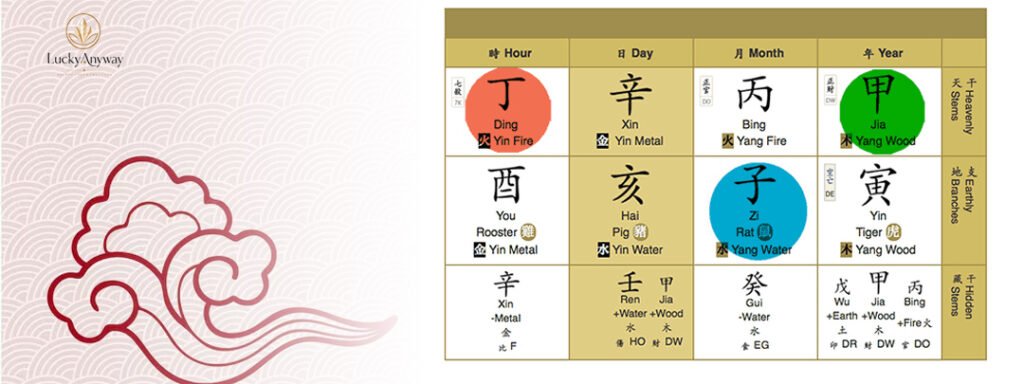
BaZi applies the Five Elements within the structure of the Four Pillars. The year, month, day, and hour of birth form the four pillars, while Heavenly Stems and Earthly Branches provide the elemental framework through which the chart is interpreted.
The Day Master’s element provides an important reference point. From there, a practitioner considers the Month Branch and seasonal influence, the supporting and controlling relationships, the distribution of the Five Elements, and the broader structure of the chart.
This is a significant step beyond simply saying that someone is “a Wood person” or “a Water person.” The same Day Master can exist in very different circumstances, and therefore the appropriate interpretation can also differ.
Classical Zi Ping traditions place particular importance on the Month Branch when assessing the structure of a chart. Other methods consider supporting and restraining, adjusting seasonal climate, removing an imbalance, and establishing useful relationships among the elements.
If you want to see how the Five Elements are applied to a personal birth chart rather than a general zodiac description, you can explore the LuckyAnyway BaZi Analysis.
A personal BaZi judgment cannot be completed by identifying one elemental label. The important question is how that element functions within the entire chart. This is why two people who appear to share the same elemental association can still require very different interpretations.
Are the Five Elements Used the Same Way in BaZi, Feng Shui, and Other Traditions?
The Five Elements are shared across several branches of traditional Chinese thought, but the methods are not identical.
BaZi examines birth information and the structure of the Four Pillars. Feng Shui applies Five Elements within environmental, directional, spatial, and qi-related considerations. Other divination traditions may use the same elemental vocabulary within entirely different technical frameworks.
Therefore, knowing that two systems both use Wood, Fire, Earth, Metal, and Water does not mean that a rule from one system can simply be transferred into another.
Keeping these distinctions clear is important if you want to understand Chinese metaphysical traditions rather than only their modern simplified versions.
Can the Five Elements Be Used to Choose Spiritual Jewelry?
They can, but the method of selection matters.
A Five Elements bracelet or other spiritual product can carry a meaningful traditional association. Color, material, elemental symbolism, and intended purpose may all be considered. For a general symbolic choice, that level of interpretation may be enough.
A personal recommendation is different. If the intention is to choose a product according to someone’s individual Five Elements characteristics, the traditional basis should ideally begin with the person’s actual birth information rather than a generic zodiac-year label.
This is the distinction we consider important at LuckyAnyway. We do not treat traditional symbolism as a random collection of attractive labels. The product should have a reason behind its association, and a personal recommendation should be based on an appropriate traditional framework.
If you are uncertain about which traditional approach fits your situation, you can contact us and explain what you are looking for. Starting with the intention is usually more useful than starting with a product color.
If you are choosing a Five Elements product for yourself, first decide whether your purpose is cultural symbolism, personal reflection, or a selection connected with your BaZi. These are different levels of use and should not be treated as interchangeable.
Where Should a Beginner Start Learning the Five Elements?
Start by learning the Five Elements as a system rather than memorizing five colors or five personality descriptions. Understand their traditional qualities, their relationship with the seasons, the Five Virtues, and the generating and controlling cycles.
The next step is to understand how these principles appear through the Heavenly Stems and Earthly Branches. From there, BaZi introduces more specific questions concerning the Day Master, Month Branch, strength, seasonal climate, and the relationships that determine how the Five Elements function in an individual chart.
This approach also explains why we believe spiritual products should not be separated completely from the tradition they represent. A bracelet, talisman, or other symbolic object can be meaningful, but its traditional meaning becomes much clearer when the principles behind it are understood.
You can learn more about the philosophy behind LuckyAnyway and our approach to traditional Chinese culture on our About Us page.
Frequently Asked Questions
What are the Five Elements in Chinese philosophy?
The Five Elements are Wood, Fire, Earth, Metal, and Water. In traditional Chinese thought, they describe changing qualities and relationships rather than five literal physical substances. They are connected with seasons, directions, generation and control, and other traditional correspondences.
What are the Five Virtues associated with the Five Elements?
The traditional correspondences are Wood with Ren (仁), benevolence; Fire with Li (礼), propriety; Earth with Xin (信), trustworthiness; Metal with Yi (义), righteousness; and Water with Zhi (智), wisdom. These are traditional philosophical correspondences, not fixed personality tests.
Does having a certain Five Element mean I have that personality?
Not by itself. The traditional association between Wood and benevolence, Fire and propriety, and the other virtues describes a philosophical correspondence. Personal character and BaZi interpretation require a much broader context.
Does being “missing” an element mean I should add it?
Not necessarily. In BaZi, an element should not be judged only by whether it appears visibly in a simplified chart. Seasonal strength, relationships, the Day Master, and the overall structure must be considered before deciding whether an element is actually useful.