
The Ten Heavenly Stems Explained: Their Five Elements and Meanings
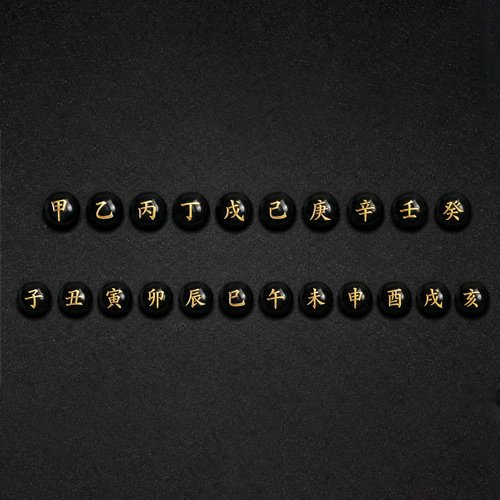
Understanding the Ten Heavenly Stems and Their Role in BaZi
The Ten Heavenly Stems are the ten fundamental symbols used in BaZi (Four Pillars of Destiny) to describe the visible qualities of time and elemental interaction. They represent the Five Elements through Yin and Yang divisions, but they are not simple personality labels. In traditional BaZi analysis, a Heavenly Stem must be understood together with season, structure, strength, and the relationship between all elements in the chart.
Many people first encounter BaZi through statements such as “I am Jia Wood” or “I am a Fire person.” While this may introduce the basic concept, classical analysis goes further. A Heavenly Stem is a starting point for understanding how a person’s chart functions, not a complete description of who someone is.
What Are the Ten Heavenly Stems in BaZi?
In BaZi, the Four Pillars consist of Heavenly Stems and Earthly Branches. Each pillar contains an upper component (Stem) and a lower component (Branch), creating a framework for analysing the interaction between time, elements, and life patterns.
The Ten Heavenly Stems are:
- Jia Wood (甲木) and Yi Wood (乙木)
- Bing Fire (丙火) and Ding Fire (丁火)
- Wu Earth (戊土) and Ji Earth (己土)
- Geng Metal (庚金) and Xin Metal (辛金)
- Ren Water (壬水) and Gui Water (癸水)
Each pair represents one of the Five Elements divided into Yin and Yang expressions. This division is important because two stems belonging to the same element can behave in very different ways.
Insight — A Heavenly Stem is a reference point, not a final conclusion.
Traditional BaZi does not judge a person by one symbol alone. The same Heavenly Stem can express different qualities depending on the season, support, and overall chart structure.
How Are the Ten Heavenly Stems Connected to the Five Elements?
The Five Elements provide the foundation of BaZi theory: Wood, Fire, Earth, Metal, and Water. The Ten Heavenly Stems represent these five categories while showing their Yin and Yang characteristics.
However, the meaning of an element is not fixed. For example, Wood represents growth and development, but Jia Wood and Yi Wood express this principle differently. One may represent upright expansion, while the other reflects flexibility and adaptation.
| Heavenly Stem | Five Element | Yin / Yang | Traditional Image | Professional Consideration |
|---|---|---|---|---|
| Jia Wood (甲木) | Wood | Yang | Tall tree, upright growth | Requires evaluation of roots, season, and support |
| Yi Wood (乙木) | Wood | Yin | Vines, flowers, flexible plants | Depends on environment and interaction |
| Bing Fire (丙火) | Fire | Yang | Sunlight, broad illumination | Consider strength and seasonal condition |
| Ding Fire (丁火) | Fire | Yin | Candle flame, refined warmth | Depends on whether the flame is supported or weakened |
| Wu / Ji Earth (戊己土) | Earth | Yang / Yin | Mountain and cultivated soil | Requires analysis of stability and function |
This table shows only the foundation of the Ten Heavenly Stems. Their deeper meaning appears when they interact with the rest of the BaZi chart.
Why Are Yin and Yang Differences Important in the Ten Heavenly Stems?
A common misunderstanding is to think Yang elements are always stronger and Yin elements are always weaker. Traditional BaZi does not view them in this way.
Yang describes a more outward, active, and expanding quality. Yin describes a more refined, inward, and adjusting quality. Both have their own functions within the Five Element system.
For example, Geng Metal and Xin Metal are both Metal, but their expressions differ. Geng Metal is often associated with raw metal that requires refinement, while Xin Metal is compared to polished metal that emphasizes precision and quality.
How Do Jia Wood and Yi Wood Represent Different Forms of Growth?
Among the Ten Heavenly Stems, Wood is often the first element people learn because it represents the beginning of growth and development. However, traditional BaZi does not treat all Wood as identical. Jia Wood (甲木) and Yi Wood (乙木) show two different expressions of the same element.
Jia Wood (甲木): Upright Growth and Structure
Jia Wood is Yang Wood. It is traditionally compared to a tall tree, such as a pine tree that grows upward with a clear direction. Its nature reflects structure, stability, and the ability to develop toward a goal.
However, a strong tree does not exist independently. Its condition depends on roots, soil, water, sunlight, and seasonal timing. In BaZi analysis, Jia Wood is never judged only by the fact that it is Wood. Practitioners examine whether it has foundation, whether the season supports it, and whether the surrounding elements allow healthy growth.
Yi Wood (乙木): Flexibility and Adaptation
Yi Wood is Yin Wood. It is often compared to vines, flowers, or smaller plants that adapt to their surroundings. Instead of standing alone like a large tree, Yi Wood represents connection, flexibility, and the ability to respond to changes.
This does not mean Yi Wood is weaker than Jia Wood. Yin and Yang describe different qualities, not a ranking system. In the right environment, flexibility can become a great strength.
Insight — The same Heavenly Stem can create different results in different environments.
Traditional BaZi does not ask only “What element are you?” The deeper question is “How does this element function inside your complete chart?”
Why Can Two People With the Same Heavenly Stem Be Completely Different?
One of the most important principles in traditional BaZi is that the Day Master cannot be interpreted separately from the entire chart. Two people may both have Jia Wood as their Day Master, yet their life patterns and strengths may be completely different.
The reason is that the season, supporting elements, and overall structure change how the Heavenly Stem operates.
| Comparison | Jia Wood Born in Spring | Jia Wood Born in Autumn |
|---|---|---|
| Seasonal Influence | Wood receives seasonal support and naturally develops strong vitality. | Metal influence becomes stronger, creating a different environment for Wood. |
| Main Evaluation | Consider whether growth needs direction, control, or proper release. | Consider support, roots, and whether the structure can handle external pressure. |
| Professional Focus | Balance between strength, expression, and regulation. | Balance between protection, adjustment, and development. |
This example explains why professional BaZi analysis cannot stop at identifying a Heavenly Stem. The same element requires different interpretation depending on the complete structure.
What Are the Traditional Meanings of the Ten Heavenly Stems?
The following descriptions represent traditional symbolic qualities. They are not fixed personality labels. In practical BaZi analysis, these qualities must always be adjusted according to strength, season, and the relationship between elements.
Jia Wood (甲木) and Yi Wood (乙木)
Jia Wood represents upright growth, structure, and expansion, like a tall tree reaching toward the sky. Yi Wood represents flexibility, connection, and adaptation, like plants that grow according to their environment.
Bing Fire (丙火) and Ding Fire (丁火)
Bing Fire is Yang Fire, often compared to sunlight. It represents broad illumination and outward expression. Ding Fire is Yin Fire, compared to a candle flame, representing refined warmth and focused influence.
Wu Earth (戊土) and Ji Earth (己土)
Wu Earth resembles a mountain or strong foundation. It emphasizes stability and endurance. Ji Earth resembles cultivated soil, representing preparation, nourishment, and careful management.
Geng Metal (庚金) and Xin Metal (辛金)
Geng Metal represents raw metal and decisive transformation. Xin Metal represents refined metal, precision, and the process of polishing quality.
Ren Water (壬水) and Gui Water (癸水)
Ren Water resembles rivers and oceans, representing movement, breadth, and strong flow. Gui Water resembles rain or dew, representing subtle influence, observation, and quiet nourishment.
Advice — Avoid choosing Five Element products from one symbol alone.
A Heavenly Stem provides valuable information, but it does not automatically reveal the favorable elements of a BaZi chart. Traditional analysis requires understanding the complete interaction of the Four Pillars.
What Is the Relationship Between the Ten Heavenly Stems and Five Virtues?
In traditional Chinese thought, the Five Elements are sometimes associated with Five Virtues: Wood with Ren (仁), Fire with Li (礼), Earth with Xin (信), Metal with Yi (义), and Water with Zhi (智).
However, these associations describe potential qualities within traditional philosophy. They are not direct predictions of personality.
For example, Wood may symbolize kindness and growth, but whether this quality appears positively depends on whether the Wood in the chart is balanced, supported, or excessive.
Can You Choose Five Element Accessories Based Only on Your Heavenly Stem?
The answer is no. A Heavenly Stem is an important starting point, but it is only one part of the BaZi system.
Traditional practitioners consider:
- The Month Branch and seasonal strength.
- The strength and condition of the Day Master.
- The balance between supporting and challenging elements.
- The role of favorable elements within the entire chart.
This is why LuckyAnyway approaches Five Element understanding through traditional BaZi principles rather than simple zodiac categories or single-element assumptions.
If you would like to understand your own elemental structure more deeply, the next step is a complete BaZi Analysis based on your Four Pillars.
Our approach to traditional knowledge and product philosophy can be explored further through our About Us page.
Frequently Asked Questions About the Ten Heavenly Stems
What is my Heavenly Stem in BaZi?
Your Heavenly Stem is determined by your Four Pillars chart. The Day Pillar’s Heavenly Stem is commonly used as the Day Master reference point in BaZi analysis.
Is my Heavenly Stem the same as my Chinese zodiac sign?
No. The zodiac sign mainly comes from the Year Branch, while the Heavenly Stem is part of the broader Four Pillars system.
Does my Heavenly Stem determine my personality?
Not by itself. Traditional BaZi evaluates the interaction of all elements rather than assigning personality traits from one symbol.
Should I select Five Element products based on my Heavenly Stem?
A Heavenly Stem provides useful information, but responsible Five Element recommendations require analysing the complete BaZi structure first.
The Ten Heavenly Stems are the language used by BaZi to describe elemental qualities and interactions. Understanding them is the beginning of traditional analysis, but true interpretation comes from seeing how the entire chart works together.