
Trust the Journey: What Chinese Five Elements Can Teach Us About Uncertainty
When the Outcome Is Uncertain, What Can You Actually Control?
When the outcome is uncertain, you can still control how you prepare, how seriously you act, and how you respond when circumstances change. Faith can give that effort a direction: do what belongs to you, then accept that the final result may not be entirely yours to command. This is what makes Jake Matthews’ approach interesting. His idea of trusting the journey is not simply about hoping for a good outcome. It is about preparing fully while making peace with the part of life that remains outside your control. That distinction has an unexpected connection with traditional Chinese Five Elements thinking.
What Does “Everything Happens for a Reason” Really Mean?
The phrase “everything happens for a reason” can sound passive if it is taken too literally. Used carelessly, it can become an excuse to stop making decisions: whatever happens was meant to happen, so there is nothing left to do.
That is not the most useful way to understand Matthews’ perspective.
When discussing the difficult experience of his fight with Neil Magny, Matthews focused on something very practical. He could not go back and change what had already happened. Rather than allowing the controversy to dominate his next fight, his family life, or his preparation, he chose to move forward. He also connected that attitude with his faith and his belief that he had done everything he could.
There is an important sequence here:
- First, take responsibility for what you can do.
- Second, make the strongest decision available under the circumstances.
- Third, accept that other factors may still change the result.
- Finally, continue rather than becoming trapped by what cannot be changed.
That is very different from simply “letting fate decide.”
Why Did an Unexpected Opponent Not Destroy Matthews’ Preparation?
One of the most revealing parts of Matthews’ story came before his 2026 return to competition. His original opponent, Muslim Salikhov, withdrew from the event. For a professional fighter preparing for a scheduled bout, that creates genuine uncertainty: the training camp has already been built around a particular opponent, yet suddenly there may not even be a fight.
Matthews did something simple. He continued training.
He explained that if he was meant to fight on that card, an opponent would eventually appear; if there was no opponent, then perhaps he was not meant to fight on that card. Instead of allowing the uncertainty to stop his routine, he kept preparing. Carlston Harris eventually stepped in, and Matthews went on to win their May 30, 2026 bout by unanimous decision.
The important point is not whether someone agrees with his religious belief. The practical lesson is the relationship between preparation and uncertainty.
He did not know who his opponent would be, but he knew what his responsibility was.
That distinction is useful in ordinary life as well. You may not know whether a business decision will work, whether a relationship will develop as expected, whether an opportunity will arrive, or whether a carefully made plan will survive changing circumstances.
You can still prepare.
How Does Traditional Chinese Thought Understand Uncertainty?
Traditional Chinese thought does not generally treat change as an abnormal interruption to an otherwise fixed world. Change is part of the structure of the world itself.
This is one reason the Yijing has remained important within the traditional Chinese intellectual tradition. Its concern is not simply with predicting a fixed future. It examines changing situations, relationships, movement, timing, and appropriate response.
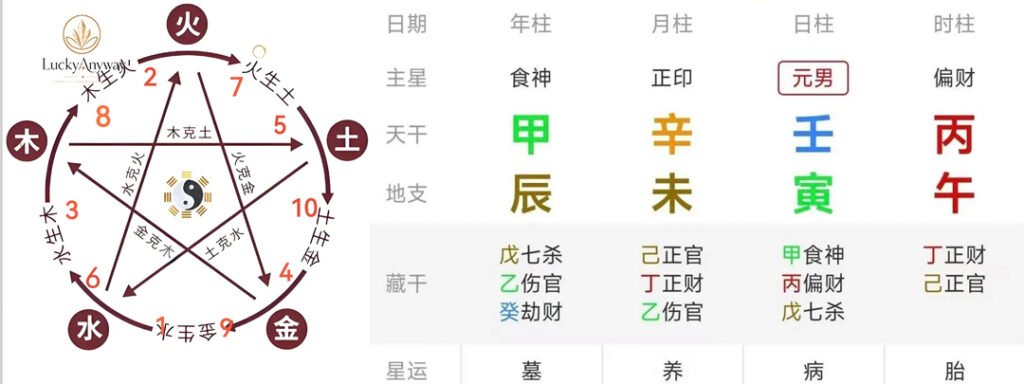
The same principle becomes more specific in BaZi analysis. A BaZi chart is not properly understood as a simple list of five elements. The Year, Month, Day, and Hour create a structure. The Day Master has a particular seasonal environment. Roots, support, combinations, clashes, structure, strength, weakness, and climate all influence how the chart should be read.
This is why traditional analysis can offer a different perspective on uncertainty.
Instead of asking only, “What will happen to me?” a practitioner can ask, “What conditions am I dealing with, and what response is appropriate under those conditions?”
That is a much more useful question.
Why Is Timing More Important Than Simply Counting the Five Elements?
One of the most common modern shortcuts is to count the five elements and immediately decide that the least visible element must be added.
Traditional BaZi reasoning is more demanding.
The Month Pillar establishes the seasonal environment, and that environment changes the meaning of the other elements. The Day Master must be examined for roots and support. The overall structure must be considered before deciding whether a particular element is actually useful.
Even the question of whether a person is strong or weak cannot be answered responsibly by counting appearances alone.
Consider two people with the same Day Master. One may be strongly rooted and supported by the surrounding structure. Another may have the same Day Master but face a completely different seasonal and structural environment. Giving both people the same bracelet simply because they share one label ignores the very reason traditional BaZi analysis exists.
| Question | Simple Online Approach | Traditional Consideration | Why It Matters | Practical Decision |
|---|---|---|---|---|
| Which element is missing? | Add the least visible element. | Check whether that element is actually favorable within the complete structure. | Absence does not automatically mean deficiency. | Do not choose only from an element count. |
| What does the Day Master tell me? | Use it as a personality label. | Examine season, roots, support, structure, strength and weakness. | The same Day Master can appear in very different charts. | Read the entire structure before choosing. |
| What role does timing play? | Ignore timing and use one permanent formula. | Consider seasonal and changing conditions. | The useful emphasis may change with circumstances. | Think in terms of timing, not fixed labels. |
| What is the purpose of a bracelet? | Use a generic lucky color or symbol. | Connect the object with a considered traditional framework. | Personalization gives the object a clearer reason for being chosen. | Choose according to analysis rather than fashion alone. |
| What if the future is unclear? | Look for a guaranteed prediction. | Understand the present conditions and prepare an appropriate response. | Uncertainty cannot always be removed. | Control preparation, judgment and action. |
What Can a Five Element Bracelet Represent During an Uncertain Period?
This is where the idea becomes relevant to a physical product.
A personalized Five Element bracelet is not chosen simply because one color looks attractive or because an online chart says a particular element is “missing.” Its traditional value begins with the reasoning behind the combination.
For example, a bracelet may be designed after considering the Day Master, seasonal environment, rooting, overall balance, and the relationship between the elements. The purpose is to create a combination with a traditional reason behind it rather than attaching a generic meaning to a color.
For someone going through uncertainty, that can give the object a more personal role. It becomes something connected to a specific understanding of the wearer rather than another mass-produced lucky accessory.
Explore the LuckyAnyway Five Element Collection if you want to see how personalized crystal bracelets can be approached through this traditional framework.
The bracelet does not need to tell you exactly what tomorrow will bring. Its role can be much more grounded: carrying a chosen traditional framework with you while you continue making your own decisions.
How Should You Choose a Bracelet Without Falling Into the “Missing Element” Trap?
Start with the chart, not the product.
A responsible selection process should ask what the person’s BaZi structure actually requires before deciding which elements, materials, or symbolic components are appropriate.
The distinction between having an element and benefiting from an element is especially important. These are not the same question.
For that reason, a proper analysis considers the Day Master together with seasonal conditions, roots, structure, strength and weakness, and the broader relationships operating inside the chart. In some cases, climate adjustment may deserve particular attention before a simple strength-versus-weakness conclusion is made.
If you want to begin with the underlying chart rather than jumping directly to a product, BaZi Analysis at LuckyAnyway provides the appropriate starting point.
This is also why personalized selection should not be reduced to “your element is X, so wear X.” Traditional practice is more about relationships and conditions than isolated labels.
Why Does LuckyAnyway Take This Approach?
LuckyAnyway is built around a simple idea: traditional knowledge should not be reduced to fashionable metaphysical slogans.
Five Elements, BaZi, Feng Shui, and related traditions contain their own systems of reasoning. Once those systems are simplified too aggressively, the customer may receive an answer that sounds convenient but has little connection to the traditional method itself.
That is why the LuckyAnyway approach focuses on understanding before recommendation.
The goal is not to make uncertainty disappear with a promise. It is to give the customer a more thoughtful relationship with traditional practice and with the object they choose to carry into daily life.
You can also read more about the principles behind the brand through LuckyAnyway’s approach and story.
Frequently Asked Questions
Is “trust the journey” the same as believing that everything is predetermined?
No. Trusting the journey does not require abandoning judgment or effort. In Matthews’ case, the idea is closely connected with doing everything he can and then accepting the part of the outcome he cannot control. That is a very different attitude from refusing to act because “fate” has already decided everything.
Should I choose a Five Element bracelet according to my missing element?
Not automatically. Traditional BaZi analysis does not simply count the five elements and add whichever one appears least. Seasonal conditions, the Day Master, roots, structure, strength and weakness, climate, and relationships among the elements all need to be considered. A visible absence does not by itself prove that an element should be strengthened.
Can a personalized bracelet be meaningful when I am facing uncertainty?
Yes. A personalized bracelet can connect an everyday object with a traditional framework selected according to the individual’s BaZi considerations. Its meaning comes from that reasoning and from the person’s relationship with the tradition. It can become a physical reminder of what has been considered, while the person continues to make decisions and respond to circumstances in real life.
Trust the Journey, But Know What Belongs to You
The most interesting part of Jake Matthews’ story is not simply the phrase “trust the journey.” It is the discipline behind it.
He prepares. He trains. He enters the fight. He gives his effort. But he also recognizes that not every variable belongs to him.
That distinction is useful far beyond combat sports.
Traditional Chinese thought has long paid attention to timing, changing conditions, relationships, and the difference between forcing a situation and responding appropriately to it. BaZi does not become more traditional by giving people more confident predictions. It becomes more useful when the structure is actually understood.
The same principle applies when choosing a Five Element bracelet.
You do not need to pretend that uncertainty does not exist. You do not need to believe that one bracelet can dictate every event in your life. What matters is having a reason behind your choice, understanding the traditional framework involved, and carrying that understanding into your everyday decisions.
Sometimes the future will remain unclear.
You can still prepare.
You can still choose carefully.
You can still move forward.
And sometimes, trusting the journey simply means knowing what belongs to you—and having the faith to let go of what does not.