
Can a Feng Shui Bracelet Help With Balance?
Yes. A Feng Shui bracelet can be chosen as a personal practice for balance, particularly when its materials, colors, symbols, and Five Element associations are selected with a clear traditional purpose. In Chinese metaphysical practice, however, balance does not mean making everything equal. It means establishing a suitable relationship between different forms of Qi, Yin and Yang, the Five Elements, personal conditions, and surrounding influences. That is why a feng shui bracelet for balance should be selected according to its intended purpose rather than a simple online formula.
This distinction becomes especially important when a customer is choosing between a general balance bracelet, a Feng Shui bracelet, a Five Element bracelet, or a personalized design based on BaZi. They may look similar on a product page, but the traditional reasoning behind them can be quite different.
What Does Balance Mean in Feng Shui?
In Feng Shui, balance is closely connected with the movement and relationship of Qi. Traditional Feng Shui does not treat a space as a collection of isolated objects. It considers how forms, directions, entrances, pathways, water, mountains, buildings, openings, and internal arrangements interact with one another.
This is why the traditional idea of harmony is dynamic. A house does not become harmonious simply because every direction contains the same amount of something. A personal object follows a similar principle: its meaning comes from the relationship between its symbolism, intended use, and the person carrying it.
When people search for a bracelet for balance, they often mean one of several things. They may want a sense of harmony in daily life, an object connected with Five Element symbolism, a Feng Shui-inspired personal item, or a bracelet selected according to their own BaZi.
These intentions should not be mixed together.
If the intention is general auspiciousness, the design can be selected around traditional blessing meanings. If the intention is Five Element harmony, the elemental composition deserves closer attention. If the customer wants a personal arrangement, the birth chart becomes the proper starting point.
This is the first distinction I make when discussing these products with customers: decide what kind of balance you are seeking before deciding which stone you want to wear.
How Do the Five Elements Create Balance?
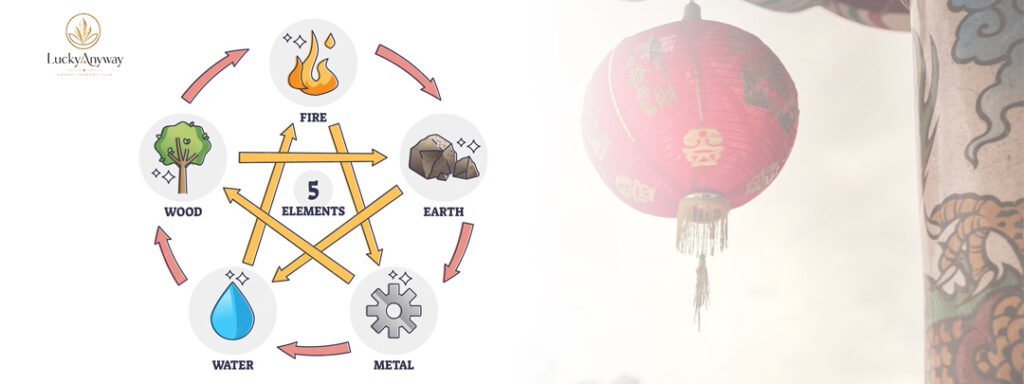
The Five Elements—Wood, Fire, Earth, Metal, and Water—provide one of the central frameworks for understanding balance in Chinese traditional thought.
They are not simply five categories of color or five types of crystal. Each element has its own character and participates in relationships of generation and control.
Wood → Fire → Earth → Metal → Water → Wood
The controlling relationships move through another pattern: Wood controls Earth, Earth controls Water, Water controls Fire, Fire controls Metal, and Metal controls Wood.
This gives the Five Elements a living structure. When discussing five element balance, the question is therefore not simply “Which element do I have less of?” A more useful question is “How are the elements interacting, and what role does each one play in this particular situation?”
Wood is associated with growth, development and flexibility. Fire carries brightness, warmth and expression. Earth relates to stability, nourishment and containment. Metal is associated with refinement, structure and judgment. Water relates to movement, depth, adaptability and wisdom.
These qualities can be brought into bracelet design through materials, colors, natural stones, symbolic elements, and arrangement. The bracelet then becomes a wearable expression of a particular elemental direction.
Why Is Five Element Balance Not the Same as Equal Elements?
This is one of the most important distinctions in traditional practice.
A common online approach is to count Wood, Fire, Earth, Metal and Water in a birth chart and then try to increase whichever element appears least often. It looks convenient because the answer is immediate. Traditional BaZi judgment, however, involves much more than counting visible elements.
The Month Command, Day Master, seasonal conditions, strength and weakness, combinations, clashes, hidden stems, structure, and useful elemental relationships all matter. The same element can have a very different role in two different charts.
Consider seasonal conditions. A chart born in a cold and damp environment may require a different elemental treatment from a chart exposed to strong heat and dryness. A person with a strong Day Master may also have a different requirement from someone with a weak Day Master, even if their simple element counts look similar.
That is why I would never build a personalized five element bracelet from an element-counting chart alone. The count can be a reference, but it is not the whole judgment.
For customers who want a personal analysis before choosing a bracelet, LuckyAnyway’s BaZi Analysis provides a more appropriate starting point because the bracelet can then be considered in relation to the complete Four Pillars.
How Does a Feng Shui Bracelet Relate to Personal Practice?
A Feng Shui bracelet brings traditional ideas into a personal, wearable form. The design may combine natural stones, colors, elemental associations, auspicious motifs, inscriptions, or other cultural symbols.
The important consideration is coherence.
If a bracelet is described as a Feng Shui bracelet, I would expect the design to have a reason behind its symbolic direction. If it is presented as a Five Element bracelet, the elemental composition should have a clear relationship with the intended use. If it is personalized, the selection should have an identifiable connection with the customer’s traditional analysis.
This gives the customer something much more useful than a list of fashionable stones. It gives them a reason for the arrangement.
| Traditional Topic | Traditional Approach | Common Online Saying | Professional Distinction | Practical Choice |
|---|---|---|---|---|
| Five Element balance | Studies relationships among the elements | Make all five elements equal | Balance concerns suitability, not equal quantity | Consider the role of each element |
| Missing element | Judged through the complete chart | Add whatever is missing | Presence and usefulness are different matters | Examine season, strength and structure |
| Bracelet color | Can express elemental symbolism | One color determines one result | Color is one part of the selection | Consider color with material and purpose |
| Feng Shui bracelet | Uses Feng Shui-related symbolism | Any lucky bracelet is automatically Feng Shui | Feng Shui has its own traditional framework | Identify the intended Feng Shui direction |
| BaZi matching | Uses the Four Pillars as a complete structure | The Day Master alone decides everything | Multiple factors must be considered together | Use a complete traditional analysis |
This distinction is particularly useful when shopping. A customer who simply wants an auspicious bracelet can choose according to its traditional meaning. A customer who wants personal elemental matching deserves a deeper level of selection.
How Should You Choose a Feng Shui Bracelet for Balance?
Start with the purpose. This sounds simple, but it prevents most purchasing mistakes.
If your intention is general harmony, look for a bracelet whose traditional symbolism reflects harmony, auspiciousness, stability, or another quality you personally want to carry into daily life.
If your interest is specifically five element harmony, then examine the elemental direction of the bracelet. Look at the materials and colors together rather than choosing from color alone.
If the purpose is personal matching, move directly to BaZi analysis. That is where the difference between a general product and a personalized arrangement becomes meaningful.
In my experience, customers often begin with the stone they like visually. There is nothing wrong with appreciating the appearance of a natural crystal, but when the purpose is traditional matching, I would reverse the order: establish the purpose first, determine the traditional direction second, and choose the material third.
That small change makes the buying process much more precise.
What Is the Difference Between a Feng Shui Bracelet and a Five Element Bracelet?
The two can overlap, but they should not automatically be treated as the same product.
A Feng Shui bracelet is generally connected with Feng Shui symbolism, auspicious forms, elemental associations, and personal practice. Its selection may be guided by the intended purpose and the symbolic framework behind the design.
A five element bracelet places greater emphasis on Wood, Fire, Earth, Metal, and Water and may be personalized according to BaZi.
A personal Feng Shui bracelet can sit somewhere between these approaches, especially when the design combines Feng Shui symbolism with an individual’s personal circumstances.
The practical question is therefore not which label sounds better. It is: what traditional reasoning was used to create the bracelet?
That is the question I would encourage a serious customer to ask before buying.
Can Crystals Be Used in a Bracelet for Harmony?
Natural crystals and stones have become closely associated with contemporary bracelet design, and they can also be incorporated into Five Element and traditional Chinese cultural frameworks through color, material, symbolism, and elemental correspondence.
Green stones, for example, are commonly connected with Wood symbolism. Red tones can be associated with Fire. Yellow and earthy tones relate to Earth. White and metallic tones correspond with Metal, while black and deep blue tones are often associated with Water.
These associations provide a useful design language, but a practitioner should still look at the complete arrangement. A crystal’s color is visible immediately; its role within a broader traditional system requires more thought.
For that reason, a crystal bracelet for balance can be selected on two levels: first according to the cultural and elemental meaning of its materials, and second according to the personal intention behind wearing it.
When both levels agree, the bracelet feels much more purposeful.
When Does a Personalized Five Element Bracelet Make More Sense?
Personalization becomes more relevant when the customer wants the bracelet to correspond with their individual BaZi rather than simply carry a general Five Element meaning.
A traditional BaZi assessment considers the Year, Month, Day, and Hour pillars. The Day Master provides the central reference, but it must be examined within the Month Command, seasonal environment, strength and weakness, structure, combinations, clashes, and useful elemental relationships.
This is also where five elements balance becomes more sophisticated. The objective is not to create a bracelet containing equal amounts of five different colors. It is to select an elemental direction that has a meaningful relationship with the chart.
For example, the distinction between a strong chart and a weak chart can change how an element is viewed. Seasonal conditions can also change the practical emphasis. A cold chart and a hot chart may call for very different considerations even when their visible element counts appear similar.
This is why LuckyAnyway approaches personalized bracelet selection through the broader Five Element framework rather than a simple “missing element” calculation.
The strongest traditional approach to balance is not to add more of everything. It is to understand what each element is doing within the whole system. Once that relationship is clear, the bracelet’s materials, colors, and arrangement become much easier to select with purpose.
How Does a Bracelet Become Part of Everyday Practice?
Traditional objects become meaningful through continued use. A bracelet is particularly suitable for this because it stays close to the wearer throughout ordinary activities.
The bracelet may represent harmony, a personal Five Element direction, an auspicious intention, or a connection with Chinese traditional culture. Its materials and symbolic details give the wearer something tangible to associate with that intention.
This personal connection is one reason traditional symbolic objects continue to have a place in modern life. They allow cultural meanings that were once expressed through amulets, inscriptions, auspicious objects, natural materials, and ceremonial items to appear in forms suitable for contemporary daily wear.
LuckyAnyway takes this connection seriously. The brand’s approach is rooted in traditional Chinese culture while presenting these ideas through contemporary bracelet design. You can learn more about the philosophy behind the brand through the About Us page.
What Should You Look for Before Choosing a Balance Bracelet?
Before choosing a bracelet, I recommend making the decision in this order:
- Define what “balance” means for your personal intention.
- Decide whether you are following Feng Shui, Five Elements, BaZi, or general auspicious symbolism.
- Consider the traditional meaning of the materials and colors.
- If the bracelet is personalized, examine the complete BaZi structure.
- Choose the final combination only after the traditional direction has been established.
This order may seem slower than choosing a bracelet from a color chart, but it gives the finished piece a much clearer purpose.
For those looking for personalized Five Element products, LuckyAnyway’s Five Element Collection provides a natural place to explore bracelet arrangements based on traditional elemental considerations.
Frequently Asked Questions
Can a Feng Shui bracelet help with balance?
A Feng Shui bracelet can be used as a personal practice representing harmony, auspiciousness, and traditional Feng Shui symbolism. Its selection can be made according to the intended purpose, materials, colors, symbolic forms, and, where appropriate, personal Five Element or BaZi considerations.
Should I choose a bracelet based on my missing element?
For personalized Five Element use, a complete BaZi assessment is more appropriate than simply counting missing elements. Month Command, Day Master strength, seasonal conditions, structure, and useful elemental relationships all contribute to the traditional judgment.
What is the difference between a balance bracelet and a Five Element bracelet?
A balance bracelet is a broad product description that can represent harmony and auspicious intention. A Five Element bracelet has a more specific traditional direction involving Wood, Fire, Earth, Metal, and Water. When personalized, it may also be arranged according to an individual’s BaZi structure.
Choosing Balance Through Traditional Understanding
A feng shui bracelet for balance becomes more meaningful when “balance” is understood in its traditional context. Feng Shui looks at the relationship between people and environment. The Five Elements describe generation, control, seasonal qualities, and elemental relationships. BaZi brings those principles into an individual’s birth chart.
A bracelet can then become a personal expression of these traditions through natural stones, colors, symbolic forms, and carefully considered arrangements.
The practical lesson is straightforward: do not begin with the bracelet. Begin with the purpose.
Once the purpose is clear, it becomes much easier to decide whether a Feng Shui bracelet, a Five Element bracelet, a personal Feng Shui bracelet, or a crystal bracelet for balance is the right direction.
For readers who want to explore the wider traditional approach behind LuckyAnyway, the LuckyAnyway website brings together Five Elements, BaZi, Feng Shui, traditional symbolism, and contemporary wearable designs.
When traditional knowledge is respected and the selection is made with purpose, a bracelet can carry more than an attractive appearance. It can become a personal object connected with harmony, cultural meaning, and the traditional principles that inspired its design.