
What Is Feng Shui? A Beginner’s Guide to the Ancient Chinese Practice
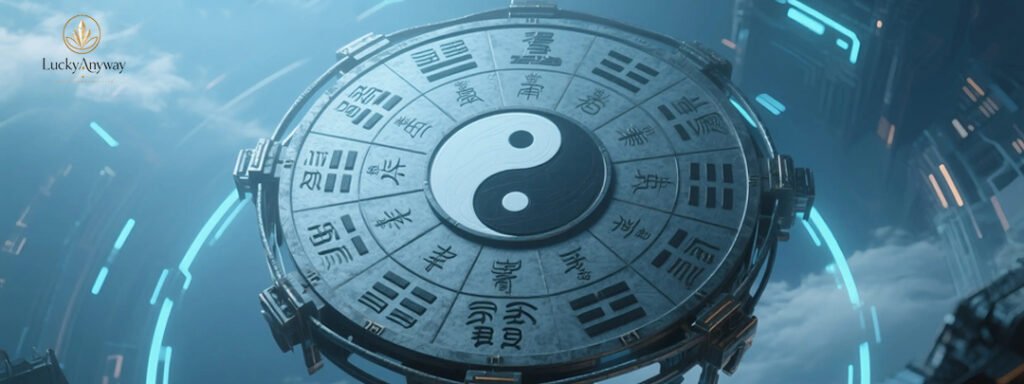
Feng Shui Begins With the Environment Around You
Feng Shui is a traditional Chinese practice of studying how people live within their surrounding environment, with particular attention to Qi, physical form, direction, space, and the relationship between them. It is not simply a method of placing lucky objects in a house. Traditional Feng Shui first asks what the environment is doing: where it is open or closed, how movement approaches the property, what is visible from the doors and windows, and whether the space can retain and circulate Qi in a balanced way. For ordinary people today, this is mainly the study of Yang House Feng Shui—the Feng Shui of homes, apartments, workplaces, and other places where living people spend their time.
This distinction matters because much of what is presented online as Feng Shui begins with an object, a color, or a “lucky corner.” Traditional practice begins somewhere else: with the place itself.
What Does Feng Shui Actually Mean?
The Chinese term Feng Shui literally means “wind and water,” but the name should not be mistaken for a simple belief in natural scenery. Wind and water are classical examples of how Qi moves through an environment. Wind disperses; water gathers and carries. The underlying concern is therefore the movement, gathering, and quality of Qi within a particular setting.
That is why an experienced practitioner does not normally begin a house assessment by asking, “Where is your wealth corner?” The more useful first questions are practical: Where is the entrance? What does the entrance face? What approaches the house? What is directly outside the windows? Is the property exposed, compressed, blocked, or supported? How does the internal arrangement relate to the external environment?
This is one of the biggest differences between traditional Feng Shui and simplified internet advice. A house cannot be understood properly by one isolated rule. A particular feature may be favorable in one setting and problematic in another because its meaning depends on position, scale, direction, distance, and the surrounding form.
For readers discovering this tradition through LuckyAnyway, that is the most useful starting point: Feng Shui is not about decorating a room with symbolic objects. It is about learning to read the environment before deciding what, if anything, should be changed.
What Is Qi in Traditional Feng Shui?
Qi is one of the most frequently used and most frequently misunderstood words in discussions of Chinese culture. It is often translated into English as “energy,” but treating Qi as a measurable Western-style physical energy can create more confusion than clarity.
In Feng Shui, Qi is better understood through its movement and relationship with the environment. A place may be described in terms of whether Qi is able to enter, move, gather, or disperse. Physical features provide clues about this movement. Roads, buildings, slopes, water, entrances, walls, openings, and interior arrangements all participate in the way an environment is read.
This is why traditional Feng Shui places so much importance on form. Before calculating complicated time-based patterns, a practitioner can already observe whether a home is exposed to a sharp corner, pressed by a large structure, struck by a straight road, or situated in an environment that feels enclosed and stagnant.
There is also a practical lesson here for homeowners: do not use the word “Qi” as an excuse to ignore obvious environmental problems. If a large building blocks every window, a road points directly toward the entrance, or an unpleasant external feature dominates the view, the physical relationship should be considered first. Traditional Feng Shui is strongest when observation comes before symbolism.
What Is the Difference Between Yin House and Yang House Feng Shui?
Traditional Chinese Feng Shui is commonly discussed through two broad applications: Yin House Feng Shui and Yang House Feng Shui.
Yin House Feng Shui concerns burial places and ancestral resting grounds. Its traditional logic is closely associated with the idea of ancestral protection and the relationship between the burial site and descendants. Mountain and water formations, terrain, surrounding forms, and the broader landscape therefore become especially important.
Yang House Feng Shui concerns places where living people reside or work. Houses, apartments, offices, shops, and other occupied spaces fall into this category.
For modern consumers, Yang House Feng Shui is the practical starting point. There is little value in overwhelming a homeowner with burial-ground theories when the actual concern is a bedroom, entrance, office, or apartment.
A practical distinction: If you are trying to improve the Feng Shui of the place where you currently live, begin with Yang House principles. Learn the wider tradition gradually rather than mixing Yin House and Yang House rules together.
How Do Traditional Feng Shui Practitioners Read a Home?
There are different schools and methods within the long history of Chinese Feng Shui, but two broad approaches are especially useful for beginners: Form and Li Qi, often associated in English with Form School and Compass or Qi-based methods.
Form focuses on what can actually be observed: mountains, water, roads, buildings, walls, openings, shapes, height, distance, enclosure, and the relationship between the property and its surroundings.
Li Qi introduces more attention to direction, time, the Eight Trigrams, the Luo Shu, stars, and other systems used to analyze spatial and temporal relationships. Some methods are highly technical and require accurate calculations.
For a beginner, however, there is a sensible order of operations: look before calculating. A complicated chart does not make a poor external environment disappear. If the physical form presents a major problem, it deserves attention before a homeowner starts collecting formulas from different online schools.
| Approach | What It Observes | Typical Questions | Best For Beginners | Practical Decision |
|---|---|---|---|---|
| Form Feng Shui | Buildings, roads, terrain, openings, shapes | What surrounds the home? | Yes | Start with what you can actually see |
| Bagua / Eight Trigrams | Directions and symbolic relationships | What does each direction represent? | Yes, with guidance | Learn the basic directional framework first |
| Compass-based methods | Direction, orientation, spatial relationships | How is the property oriented? | Moderate | Use accurate direction rather than guessing |
| Flying Stars | Time, direction, stars, changing periods | How does timing affect the space? | Later | Do not begin with advanced calculations |
| Jin Suo Yu Guan | External forms and environmental relationships | What forms surround the property? | Yes | Study visible forms before symbolic cures |
Why Does the Shape Around Your Home Matter?
This is where traditional Chinese Feng Shui becomes especially interesting for modern homes.
A house does not exist in isolation. A window may face another building. An entrance may face a long corridor or road. A sharp architectural corner may point toward the property. A large structure may stand unusually close to one side of the house. A road may curve toward or away from the property.
Traditional Form Feng Shui pays attention to these relationships because shape influences how Qi is understood to move. In Chinese practice, harmful or unfavorable forms are often discussed under the broad concept of Sha.
Common examples include sharp corners, direct approaches, oppressive structures, unfavorable curved roads, and unpleasant or contaminated surroundings. These should not be treated as automatic predictions of illness, financial loss, or disaster. A serious assessment considers the whole environment.
One of the most useful principles when dealing with an unfavorable form is simple: change the form before trying to fight the form.
If a sharp corner is visible through a window, reducing or blocking the visual exposure may be more sensible than immediately placing a symbolic object inside the room. If a direct approach reaches the entrance, landscaping, screening, or architectural adjustment may deserve consideration first. Traditional practice often values changing the physical relationship over relying entirely on an object.
What Is the Bagua in Feng Shui?
The Bagua, or Eight Trigrams, provides another important way to understand space. The eight trigrams—Qian, Kun, Zhen, Xun, Kan, Li, Gen, and Dui—are associated with directions, natural qualities, family relationships, and the Five Elements within traditional Chinese thought.
For a homeowner, the Bagua can be approached as a framework for asking better questions about different parts of a property. Instead of treating the house as one undifferentiated box, the space is considered through directional relationships.
This is also where Feng Shui naturally connects with the Five Elements. Directions and trigrams have traditional elemental associations, and these relationships can become relevant when analyzing a home.
But there is an important warning for beginners: not every Bagua diagram found online represents exactly the same method of Feng Shui. Different schools can apply directional and spatial principles differently. A decorative Bagua chart should therefore not be treated as a universal formula that overrides the actual structure and orientation of a property.
If you are interested in how personal information and the Five Elements can be considered alongside traditional Chinese systems, LuckyAnyway also provides a separate BaZi Analysis resource. That subject deserves its own explanation rather than being mixed casually into a general home Feng Shui article.
What Are the Most Common Feng Shui Mistakes Beginners Make?
The most common mistake is buying a Feng Shui object before understanding the problem.
People often see advice about mirrors, crystals, coins, plants, colors, statues, or other symbolic objects and immediately ask which one they should buy. In traditional practice, that reverses the order of judgment.
First identify the condition. Then decide whether the condition can be physically improved. Only after that should a symbolic or traditional Feng Shui object be considered as part of the response.
- Starting with objects: A cure cannot compensate for every environmental problem.
- Ignoring the exterior: What is outside the window or entrance can matter as much as what is inside.
- Mixing different schools: Combining rules from unrelated systems can produce contradictory advice.
- Taking one symbol literally: A shape or object should be considered in context rather than treated as an automatic prediction.
- Overusing mirrors: Reflection is not a universal solution, and placement requires judgment.
- Chasing annual predictions too early: Beginners are usually better served by understanding their actual home before studying advanced time-based systems.
This is also why a trustworthy Feng Shui discussion should distinguish between traditional principles, local customs, modern commercial interpretations, and simplified social-media advice. They may use the same vocabulary while giving very different recommendations.
How Should You Begin Practicing Feng Shui at Home?
Start with observation, not shopping.
Stand outside your home and look toward the entrance. Then stand at the entrance and look outward. Notice roads, buildings, corners, open spaces, walls, poles, trees, slopes, water, and anything unusually close or visually dominant.
Next, walk through the home without immediately deciding what is “good” or “bad.” Look at the entrance, major rooms, windows, circulation paths, and the relationship between public and private spaces.
Only after this first inspection should you introduce the Bagua, Five Elements, personal information, or traditional objects into the discussion.
For people who approach Feng Shui as more than interior decoration—as a traditional practice connected with belief, symbolism, and personal intention—the value is not in accumulating the largest collection of objects. The value is in making thoughtful choices with a clear understanding of why they are being made.
That is also the approach we follow at LuckyAnyway. Our interest is in traditional Chinese cultural practices and the meaning people attach to them, rather than presenting every online Feng Shui shortcut as ancient doctrine. You can learn more about our background on the About Us page.
Where Does Feng Shui Go From Here?
Once the basic idea is clear, Feng Shui becomes much easier to approach.
You can begin with the physical environment through Form Feng Shui and Jin Suo Yu Guan, then learn how the Eight Trigrams and directions provide another layer of understanding. From there, subjects such as missing corners, entrance orientation, bedroom placement, external Sha forms, Five Elements, and personal Feng Shui can be studied one at a time.
The important point is not to turn Feng Shui into a collection of superstitious rules. Traditional practice is more disciplined than that. It observes the environment, considers relationships, distinguishes different methods, and makes adjustments according to the situation.
For questions about a particular home, a personal Feng Shui concern, or how traditional Chinese products relate to your situation, you can contact LuckyAnyway directly. A useful conversation should begin with the actual circumstance rather than a predetermined object or “cure.”
Feng Shui ultimately begins with a simple habit: look carefully at where you live before deciding what you need. Once you learn to see the forms around you, understand direction, and recognize the relationship between space and Qi, the deeper traditions of Chinese Feng Shui become far easier to understand.
Why Traditional Feng Shui Still Matters Today
Modern homes are very different from the environments in which classical Chinese Feng Shui developed. People now live in high-rise apartments, work in glass offices, and look out at roads, neighboring towers, parking structures, and electrical infrastructure rather than mountains and rivers.
Yet the fundamental question remains surprisingly practical: How does the environment around a person influence the way that person experiences and uses space?
This is why traditional Feng Shui should not be reduced to an antique collection of lucky symbols. Its older observations can still provide a structured way to think about entrances, exposure, enclosure, movement, orientation, and the visual forms surrounding a property.
For someone beginning this journey, there is no need to learn everything at once. Start with your own home. Look outward. Observe the forms around the property. Understand the entrance. Then learn the Eight Trigrams and the Five Elements step by step.
When you eventually encounter talismans, crystals, bracelets, coins, mirrors, or other traditional Feng Shui objects, you will also be in a better position to understand their intended role. They should be considered within a broader traditional practice, not treated as magical replacements for careful observation and sensible environmental changes.
That distinction is important to us because Chinese traditional culture is deeper than the simplified formulas often found online. Feng Shui can be approached with belief and personal intention while still respecting the discipline and context of the tradition.
Begin with the place. Understand the form. Consider the direction. Then decide what, if anything, needs to be changed.