
How the Shapes Around Your Home Can Affect Feng Shui
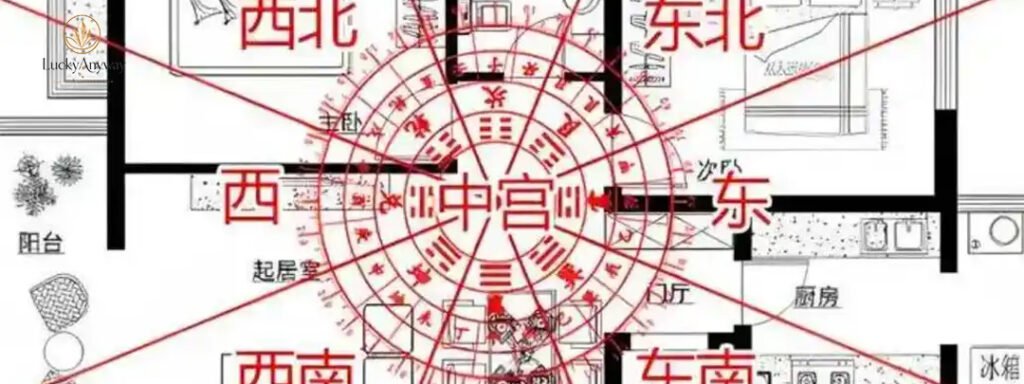
Reading the Visual Language of Your Home
The shapes around your home can affect Feng Shui because traditional practice pays attention to how form, direction, distance, movement, and visual dominance interact with a residence. A sharp corner, straight road, narrow building gap, large wall, or curved roadway does not carry exactly the same meaning in every property. What matters is the relationship between the form and the home: where it is, how close it is, what part of the house it faces, and whether it creates a strong visual or directional effect. In other words, Feng Shui does not judge shapes in isolation. It reads the relationship between the shape and the space it enters.
This distinction is worth understanding before buying a Feng Shui remedy.
Many simplified explanations teach people to recognize a shape and immediately attach a label to it. See a pointed corner? “Bad.” See a straight road? “Bad.” See a tall building? “Bad.”
Traditional practice is more demanding.
The same external shape can be insignificant in one house and important in another. That is why learning how to look is often more valuable than memorizing a long list of Feng Shui objects.
At LuckyAnyway, this practical way of looking at the environment is especially important when discussing traditional Feng Shui products. The object comes after the observation—not before it.
Why Does Shape Matter in Traditional Feng Shui?
Traditional Feng Shui begins with the environment.
Before discussing stars, calculations, personal birth information or symbolic objects, classical practice pays close attention to the physical landscape and built environment. Mountains, water, roads, buildings, walls, openings and pathways all have form. Those forms influence how space is experienced and, in traditional language, how Qi is received, directed, contained or dispersed.
This is one reason the study of 形势—form and configuration—has such a long history.
A shape matters because it is not merely a picture.
A straight road also represents movement. A narrow gap represents concentration and direction. A large wall represents obstruction. A curved road represents a different pattern of movement from a straight one.
So when a practitioner looks at a shape, the question is not simply, “What does this look like?”
The better question is:
“What does this form do to the space around the house?”
That question separates serious observation from decorative superstition.
Does the Same Shape Always Have the Same Feng Shui Meaning?
No.
This is perhaps the most useful point for a beginner to understand.
Imagine two homes facing a sharp building corner.
In the first home, the corner is several hundred feet away, partly hidden by trees, and barely noticeable from the main entrance. In the second, a large concrete corner sits close to the property and points directly toward the front door.
The visual shape is technically similar.
The Feng Shui relationship is not.
Traditional judgment depends on several layers of context:
- Distance: closer forms usually have a stronger visual relationship with the home.
- Direction: a form facing an important opening deserves more attention.
- Scale: a dominant structure can matter more than a small distant feature.
- Visibility: something hidden from the house may have less practical relevance.
- Movement: roads, traffic and flowing water introduce another dimension.
- Position: the main entrance, major windows and frequently used rooms may have different relationships with the same external form.
This is why a photograph can help, but a photograph alone cannot always provide a complete Feng Shui judgment.
You need to know where the camera was standing.
How Does Distance Change the Effect of a Shape?
Distance is one of the simplest factors and one of the most frequently ignored.
A mountain on the horizon and a wall three feet outside a window are both “large forms,” but they do not interact with a residence in the same way.
The closer a form is, the more likely it is to dominate the visual field. Its proportions become more apparent. Its direction becomes easier to perceive. It can block light, restrict the view, or create a stronger sense of enclosure.
This does not mean that every distant object is harmless. A prominent tower can remain visually important even when it is relatively far away.
The practical test is simple:
How much of your attention does the form naturally capture when you stand inside the house?
Try it yourself.
Stand at the main window for thirty seconds without deliberately searching for a Feng Shui problem. Look normally.
What do your eyes settle on?
A tree? Open sky? A neighboring building? A road? A pointed structure?
That first impression can tell you something useful about visual dominance.
Experienced observation often begins this way—quietly, before terminology is introduced.
Why Is Direction More Important Than Simply Seeing a Shape?
A shape becomes more relevant when it has a clear directional relationship with the house.
A pointed object somewhere behind your property is different from a pointed object directly facing the main entrance.
A road passing across the front of a neighborhood is different from a road that appears to run directly toward the entrance.
This is why traditional Feng Shui pays such close attention to orientation.
When examining your home, do not walk around randomly and photograph everything.
Start with the main entrance.
Stand at the threshold and look outward.
Then turn around and look inward.
Next, repeat the process at the major windows.
This simple exercise gives you a clearer picture of which external forms actually have a relationship with the house.
It also prevents a common beginner’s mistake: spending hours worrying about a feature that the residents rarely see.
What Happens When a Shape Creates Movement?
Not every important Feng Shui form is static.
Roads, vehicles, pedestrians and water introduce movement.
This is where a shape becomes more than a visual object.
A straight road heading toward a house has both form and directional movement. A curved road has a different pattern. A busy intersection behaves differently from a quiet residential lane.
Traditional practitioners therefore look at both the physical line and the activity taking place along it.
This is particularly important when considering what is sometimes called road rush or Lu Chong.
The mistake is to treat every road as the same.
Instead, ask:
- Where does the road point?
- What happens at its endpoint?
- How close is it to the property?
- How much traffic does it carry?
- Does the movement appear to terminate at the home?
A road that merely passes nearby is one thing. A strong straight line apparently terminating at the entrance is another.
That distinction is far more useful than simply memorizing the phrase “road Sha.”
How Do Sharp, Heavy, Open and Curved Shapes Differ?
One practical way to understand environmental form is to compare the qualities of different shapes rather than memorizing their names first.
| Shape Type | Typical Example | Visual Quality | What to Observe | Common Mistake |
|---|---|---|---|---|
| Sharp | Building corner, pointed roof, structure edge | Directional and concentrated | Angle, distance, alignment | Assuming every corner is harmful |
| Straight | Road, driveway, corridor | Direct and moving | Endpoint, speed, direction | Ignoring the actual movement |
| Heavy | Tall tower, large wall, massive structure | Dominant and enclosing | Height, proximity, visual pressure | Judging height without distance |
| Narrow | Gap between tall buildings | Compressed and directional | Width, depth, alignment | Calling every gap Tian Zhan Sha |
| Curved | Road, river, boundary | Flowing and changing direction | Inner or outer curve, distance | Assuming every curve is favorable |
This comparison reveals an important principle: shape alone is not the conclusion.
Shape is the beginning of the investigation.
Why Can an Open Shape Be Better Than a Perfectly “Lucky” Object?
There is a tendency in modern Feng Shui discussions to focus heavily on objects placed inside the home.
People ask which crystal should go in the living room, which charm should hang beside the door, or which symbol should face a particular direction.
Those questions can have a place in traditional practice, but they should not distract from something much larger: the quality of the surrounding space.
A home with an open, comfortable outlook can sometimes have a more important environmental advantage than a home filled with symbolic objects but surrounded by oppressive structures.
Why?
Because the outside environment is not merely decoration.
It establishes the spatial conditions in which the home exists.
This is one reason classical Feng Shui places importance on concepts such as 藏风聚气—containing and gathering Qi—rather than simply accumulating objects.
A practical interpretation is not that every house needs to be perfectly enclosed. It means that a residence should have an environment that is neither excessively exposed nor aggressively pressured by its surroundings.
That balance is easy to overlook when the conversation becomes too focused on products.
Can Hu Xing He Xiang Help You Understand Shapes?
Yes, but it should be used carefully.
呼形喝象 (Hu Xing He Xiang) is a traditional way of giving meaningful names or images to visible forms. A building may resemble an animal, a weapon, a person, or an object. These visual associations can help practitioners communicate what they see and develop an interpretive framework around the landscape.
It is also one of the most interesting parts of traditional form-based Feng Shui for beginners because it makes environmental observation memorable.
But there is a boundary that should not be crossed.
A symbolic resemblance is not automatically a verdict.
If someone says a building resembles a tiger, dragon, sword or snake, that image may be useful as an interpretive description. It should not replace the actual analysis of location, orientation, surrounding forms and relationship to the residence.
This is particularly important online, where dramatic photographs can make almost any building resemble something mysterious.
Use the image to sharpen your observation.
Do not use the image to avoid observation.
What Is the Difference Between Shape and Symbol?
This distinction becomes important when discussing Feng Shui products.
A shape is something physically present in the environment.
A symbol is something humans assign meaning to.
A pointed roof is a physical shape. A talisman representing protection is a symbolic object.
They can interact within a traditional practice, but they are not the same category.
This is why I recommend beginning with the environment before choosing a symbolic response.
If you find a sharp external corner, first determine whether it actually faces the house.
If you find a direct road, determine whether its movement truly approaches the entrance.
If a large building dominates the window, determine whether changing the visual relationship is possible.
Only after that should you consider whether a traditional symbolic practice has a place in your situation.
For someone who follows Chinese cultural traditions, a talisman or Five Element object can carry genuine spiritual and cultural significance. But its role should be understood honestly.
It is not a substitute for careful environmental judgment.
How Do Five Elements Fit Into the Reading of Form?
Five Element theory can add another level of interpretation to physical form.
Wood, Fire, Earth, Metal and Water are traditionally associated with different qualities, directions, seasons and forms. Certain shapes can therefore suggest particular elemental qualities within some traditional interpretations.
For example, pointed forms may be discussed in relation to Fire-like qualities, while broad, stable forms may invite an Earth association.
But this is where many simplified explanations become unreliable.
It is not enough to say:
“This shape looks like Fire, therefore Fire is bad.”
That is not how a serious Five Element analysis should be handled.
The relevance of an element depends on the system being used and the broader context. The environment and a person’s individual chart are also different layers of analysis.
Someone who wants to understand the personal side of Five Elements should not automatically use the house exterior as a replacement for BaZi analysis.
At LuckyAnyway’s BaZi Analysis, the focus is on the individual’s birth information and traditional BaZi framework, which is a different question from simply examining the shape of a building outside a window.
Keeping these layers separate prevents a great deal of confusion.
What Should You Look At Before Buying a Feng Shui Remedy?
Use this simple order.
First: identify.
What exactly are you seeing?
Second: locate.
Where is it in relation to the home?
Third: measure.
How close, large or visually dominant is it?
Fourth: relate.
Which entrance, window or living area does it face?
Fifth: decide.
Can the physical relationship be improved?
Sixth: consider tradition.
If physical changes are limited, does a traditional symbolic adjustment make sense for you?
This order may sound almost too simple, but it prevents one of the most common mistakes in Feng Shui shopping: purchasing a remedy for a problem that has never actually been established.
A good Feng Shui purchase should answer a real question. It should not be created by fear.
What Can You Learn From Your Home Without a Compass?
You can learn quite a lot.
Before using a compass or detailed calculations, you can observe the physical environment.
Walk around the property.
Look at the front, rear and sides.
Notice whether the home is exposed or enclosed. Observe roads and paths. Look for sharp corners. Check neighboring structures. Watch how people and vehicles move around the property.
Then step inside.
Stand at the main entrance. Look outward.
Stand at the major windows. Look outward again.
Notice which external shapes dominate your attention.
This does not replace more advanced Feng Shui methods. It gives you the physical foundation upon which those methods can be considered.
For a beginner, that is exactly where I would start.
When Should You Stop Trying to Interpret the Shape Yourself?
There is a point where photographs and simple observation stop being enough.
If several external forms overlap, if the property has unusual orientation, if multiple buildings create complicated relationships, or if you are making a major property decision, it is sensible to seek a more complete assessment.
The same applies when the question involves both the property and an individual’s personal circumstances.
Traditional Feng Shui and BaZi can complement one another, but they answer different questions.
If you are unsure what information is actually needed for your situation, you can contact LuckyAnyway rather than trying to solve every issue through a single online checklist.
A photograph of the front entrance, a simple description of the surrounding roads and buildings, and the direction the home faces can often be more useful than a long list of assumptions.
What Is the Most Practical Way to Read Your Home?
Start with your eyes.
That is still one of the best pieces of advice I can give.
Look at the forms outside your home before deciding what they mean. Notice whether they point, press, cut, surround, block, open or move. Then consider their distance and direction.
Only after that should you give the form a traditional name.
This approach also makes Feng Shui much less frightening.
A sharp corner is no longer simply “bad luck.” It becomes a physical form whose relationship with your home can be examined.
A road is no longer automatically a “Sha.” You can ask where it leads and how its movement interacts with the entrance.
A tall building is not automatically oppressive. Its distance, scale and position matter.
This is the practical strength of form-based Feng Shui.
It teaches you to pay attention to the environment you actually live in.
And for people who use Feng Shui as part of a personal spiritual or cultural practice, that is an important distinction. A meaningful talisman, protective charm or Five Element object can become part of that practice, but it should come after understanding—not instead of understanding.
LuckyAnyway’s approach begins from that same principle: observe the environment, understand the traditional framework, then choose what genuinely fits your practice.
If you would like to learn more about the philosophy behind the work and the traditional perspective we follow, you can visit our About Us page.
The goal is not to make you suspicious of every building outside your window.
The goal is to teach you how to see.
Once you learn that, Feng Shui becomes less about collecting cures and more about understanding the relationship between people, homes and the spaces around them.