
What Is Jin Suo Yu Guan Feng Shui? Understanding the Power of Form and Shape
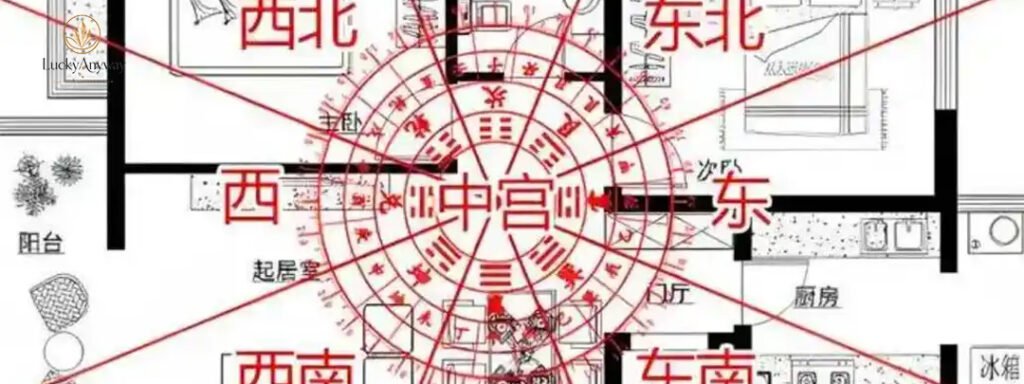
Reading Feng Shui Through Form, Shape, Sand and Water
Jin Suo Yu Guan Feng Shui is a traditional Chinese approach that places strong attention on the physical environment around a property. Rather than beginning with decorative objects or a generic floor-plan chart, it examines form, shape, height, openness, roads, buildings, and the traditional relationship between “sand” and “water” in different directions. It is often associated with the form-oriented side of Feng Shui and is also known as Guo Lu Yin Yang, or “Passing Yin-Yang,” in modern Chinese practice. For a homeowner, its most useful lesson is straightforward: look carefully at what surrounds the house before deciding what the house needs.
This makes Jin Suo Yu Guan particularly interesting for people outside China. You do not have to begin with a complicated calculation. You can start with your own street, entrance, windows, neighboring buildings, open spaces, and the shapes visible around your home.
What Is Jin Suo Yu Guan Feng Shui?
Jin Suo Yu Guan (金锁玉关) is a Chinese Feng Shui system commonly discussed within the broader tradition of Form or Landform Feng Shui. Its practical attention falls heavily on the relationship between a property and the surrounding environment, especially the distribution of what traditional practitioners describe as Sha and Shui—often translated as “Sand” and “Water.”
The English translation “Golden Lock and Jade Pass” sounds mysterious, but the working idea is much more practical than the name suggests. A practitioner studies the physical conditions around a site and relates those conditions to directional and Bagua principles.
That combination is important. Jin Suo Yu Guan is not simply a method of saying that one shape is lucky and another shape is unlucky. The form is considered in relation to its position, direction, height, movement, openness, and relationship with the property.
This is why I would not teach it by starting with a long list of “good shapes” and “bad shapes.” That encourages the wrong habit. Learn to see the environment first.
At LuckyAnyway, this is the part of traditional Feng Shui that is particularly useful for modern homeowners: learning how to observe a place before trying to change it.
Why Does Jin Suo Yu Guan Pay So Much Attention to Form?
Traditional Feng Shui does not treat a building as an isolated object. A house sits inside an environment, and that environment has shape, movement, height, openings, boundaries, and relationships.
Consider a simple example. A home may have an attractive interior, but directly outside its main entrance is a narrow road approaching the property in a strong straight line. Another home may have the same floor plan but open onto a broad, comfortable space.
The interior may be identical. The surrounding form is not.
This is why Form Feng Shui begins outside the walls.
In Jin Suo Yu Guan, the practitioner is interested in the distribution of environmental conditions around the property. Raised, solid, enclosed, or substantial features may be considered in the language of Sha, while lower, open, flowing, or receptive conditions may be understood through Shui, depending on the specific context and method.
The important point for a beginner is not to memorize a translation. “Sand” does not literally mean a pile of sand, and “Water” does not always mean a river or aquarium.
They are traditional categories for reading environmental form.
What Do “Sand” and “Water” Mean in Jin Suo Yu Guan?
Sha and Shui are among the most important ideas to understand before going deeper into Jin Suo Yu Guan.
In physical landscape Feng Shui, water can obviously mean actual water: rivers, streams, lakes, or other low and flowing areas. But in a modern city, the concept becomes broader. Roads, open spaces, entrances, low areas, windows, or other relatively open features may sometimes be considered according to the system being applied.
Likewise, “Sand” is not limited to earth or sand. Buildings, walls, higher ground, substantial structures, trees, or other raised and relatively solid features may take on the role of Sha depending on their position and relationship to the property.
This is where beginners often make a costly mistake: they see the word “Water” and immediately buy an aquarium.
That is backwards.
The question should be: what is the environmental condition, and how is it functioning in this particular location?
| Traditional Term | Basic Meaning | Modern Example | What to Observe | Common Mistake |
|---|---|---|---|---|
| Sha / Sand | Raised, solid or substantial form | Building, wall, hill, substantial structure | Height, distance and position | Assuming every large object is harmful |
| Shui / Water | Lower, open or flowing condition | River, road, open area, low ground | Movement, direction and openness | Thinking only literal water counts |
| Form | Physical shape of the environment | Corner, gap, road, building line | Shape and relationship to the home | Judging one shape in isolation |
| Direction | Spatial relationship to the property | North, South, East, West and intermediate directions | Accurate orientation | Using a generic compass diagram without context |
| Bagua | Eight Trigrams and their directional framework | Eight sectors around a property | Direction and traditional associations | Treating Bagua as a universal decoration chart |
This distinction between category and physical object is essential. Once you understand it, Jin Suo Yu Guan becomes much easier to approach without falling into the trap of literal translations.
How Does Direction Affect the Reading of Form?
Form alone is not the entire method. Direction provides the framework through which the physical conditions are interpreted.
This is where Jin Suo Yu Guan connects with the Eight Trigrams and traditional Chinese cosmological ideas. The environment is divided according to directions, and the physical distribution of Sha and Shui is considered in relation to those directions.
Some commonly circulated teachings describe particular groups of directions as favoring Sha while others favor Shui. These formulas are part of the practical teaching associated with Jin Suo Yu Guan, but they should not be presented to a beginner as a universal substitute for understanding the actual property.
Why?
Because the first question is still whether you have identified the physical feature correctly.
If a practitioner mistakes a distant open plaza for a completely different type of environmental condition, a perfect calculation based on the wrong observation will still produce a poor reading.
This is why experienced Feng Shui work is not just “knowing the formula.” It is knowing what you are actually looking at.
Why Is the Outside of the House So Important?
A modern homeowner often begins Feng Shui inside the house. They look at the bed, sofa, mirror, stove, desk, plants, or crystals.
Jin Suo Yu Guan encourages a different starting point.
Walk outside.
Stand at the main entrance and look outward. Then walk around the property if possible. Observe the buildings around you. Notice whether one side is significantly higher than another. Look for open spaces, roads, walls, gaps between buildings, large trees, sharp corners, and structures that dominate the view.
Take photographs.
Then ask which features are actually important rather than trying to label everything.
This last step is where experience becomes useful. A city contains hundreds of shapes. If you treat every object as a Feng Shui signal, you will find “problems” everywhere.
A serious reading requires hierarchy.
The main entrance matters. Major windows matter. Significant external forms matter. A distant object that can barely be seen may matter far less than a large structure immediately in front of the house.
Distance, scale and position can change the importance of a form.
That is one of the most practical lessons to take from the tradition.
What Is Hu Xing He Xiang?
Hu Xing He Xiang, often translated or discussed as “calling the shape and image,” is a more visual way of thinking about forms. A building, hill, roofline, road, tree, or other feature may resemble an animal, object, weapon, person, or symbolic image.
This can make Feng Shui surprisingly intuitive. A strange building may genuinely look like a blade. A curved road may resemble an arc. A mountain ridge may suggest an animal or another recognizable figure.
But this is where discipline matters.
The resemblance is an aid to interpretation, not a magic verdict.
If a building resembles a tiger, that does not automatically mean the property will receive “tiger energy.” The practitioner still needs to examine where that form is located, what it is doing in relation to the property, whether the form is supportive or threatening, and whether the wider configuration agrees with the interpretation.
In other words, the image gives you a language; the environment gives you the evidence.
This is an important distinction for Western readers because symbolic interpretation can otherwise become exaggerated very quickly.
Is Jin Suo Yu Guan the Same as Simply Reading Shapes?
No. This is probably the most important distinction to make before going further.
Jin Suo Yu Guan pays close attention to form, but it is not simply a game of identifying shapes. Its traditional framework also involves direction, Bagua relationships, the distinction between Sha and Shui, and the way these conditions are distributed around a property.
Someone who looks at a roof and says “that looks like a sword” has made an observation. They have not completed a Feng Shui analysis.
The next questions are much more important:
- Where is the form located?
- How close is it to the property?
- Which part of the home does it face?
- Is the form high, low, open, enclosed, moving, or static?
- What other forms surround it?
- Does the broader environmental pattern support or contradict the first impression?
This is why I would treat Hu Xing He Xiang as a useful layer of observation rather than the whole system.
How Can You Apply Jin Suo Yu Guan to a Modern Apartment?
You do not need to live beside mountains and rivers to observe the principles of environmental form.
Modern apartment buildings have simply changed the vocabulary.
A high-rise can function as a substantial form. A road can create movement. A courtyard can provide openness. A neighboring tower can create enclosure. A narrow gap between buildings can create a very different visual relationship from an open view.
Even balconies and large windows become important because they create connections between the interior and exterior environment.
For an apartment, I recommend beginning with four observations:
- Main entrance: What does the entrance face, and what approaches it?
- Main windows: What dominates the view from the rooms used most often?
- Building relationship: How close and how high are neighboring structures?
- Open and enclosed areas: Where does the property feel open, and where does it feel compressed?
This is far more useful than buying a traditional object simply because someone says your apartment “needs more Water.”
First identify the condition. Then decide whether an adjustment is appropriate.
Can Jin Suo Yu Guan Tell You What to Buy for Your Home?
It can help explain why a traditional adjustment may be considered, but it should not be turned into a shopping list.
This distinction matters to anyone who purchases Feng Shui products.
A talisman, protective item, Five Element object, crystal bracelet, mirror, coin arrangement, or other traditional item may carry symbolic and cultural meaning. But the item should have a reason for being there.
If a physical obstruction can be reduced by changing the furniture, adding a screen, improving the entrance, or changing the visual relationship, those possibilities should be considered first.
When a physical change is impossible—for example, a homeowner cannot move the neighboring high-rise—traditional symbolic practices may become more relevant to someone who wishes to incorporate them into their personal Feng Shui practice.
This is the approach I prefer: do not ask which object is lucky first; ask what situation you are actually addressing.
For readers who are interested in combining traditional Feng Shui with a broader Chinese cultural practice, LuckyAnyway approaches products as part of that larger tradition rather than as universal “cures” for every situation. More about that philosophy can be found on our About Us page.
What Are the Biggest Mistakes Beginners Make With Jin Suo Yu Guan?
The first mistake is seeing every unusual shape as a Sha.
Modern cities are full of sharp corners, glass towers, poles, signs, bridges and unusual architecture. If every one of them were automatically harmful, almost nobody would have a peaceful home.
The second mistake is ignoring distance. A huge building far away is not necessarily equivalent to a huge building immediately outside your window.
The third mistake is ignoring direction. A physical feature needs to be located within the spatial framework of the property before its traditional significance can be discussed properly.
The fourth mistake is using a formula without checking the environment. This is particularly common when people find a short online explanation of the “four Sha and four Shui” principle and immediately apply it to a floor plan without properly identifying the external forms.
The fifth mistake is treating symbolic objects as replacements for environmental judgment.
These mistakes have one thing in common: they reverse the order of the practice.
Observation should come before interpretation, and interpretation should come before adjustment.
How Does Jin Suo Yu Guan Connect With the Bagua and Five Elements?
Jin Suo Yu Guan does not exist separately from the wider world of Chinese metaphysical thought. Its methods are commonly discussed in connection with the Bagua, Luo Shu, Yin-Yang theory, and Five Element relationships.
The Bagua gives direction a traditional language. The Five Elements provide another framework for understanding relationships between different qualities. Yin and Yang help describe contrasts such as high and low, solid and open, active and still.
But these concepts should not be thrown together simply because they all appear in Chinese metaphysics.
For example, a person’s personal Five Element situation belongs more naturally to BaZi when the question concerns birth information and individual constitution within that system. A building’s external environment is a Feng Shui question.
These traditions can complement each other, but they should not be confused.
If you are interested in the personal side of Chinese metaphysics, LuckyAnyway keeps that subject separate through its BaZi Analysis section. This separation helps keep the reasoning clear rather than turning every question into a vague “energy” explanation.
What Should You Look at Before Using a Feng Shui Remedy?
Before purchasing anything, take five minutes to observe.
Stand outside. Look toward the entrance. Look from the entrance outward. Take a photograph. Then stand at the major windows and do the same thing.
Ask yourself what is visually dominant.
Is there a sharp corner? A large wall? A narrow gap? A road? A large open area? A building that feels overwhelmingly close? A structure that blocks one side? A pleasant, balanced open view?
Then consider whether the issue can be physically improved.
Maybe a screen can soften the view. Perhaps furniture can be moved. Perhaps a window treatment can change the visual relationship. Maybe the problem is not significant enough to require any intervention at all.
Only after this should you consider a traditional symbolic adjustment.
This approach also protects you from unnecessary fear. Feng Shui should help you understand your environment, not make you frightened of every object outside your window.
Why Is Jin Suo Yu Guan Useful for Western Feng Shui Beginners?
For a Western reader, one of the greatest strengths of Jin Suo Yu Guan is that it gives you something concrete to observe.
You do not have to begin by memorizing dozens of technical terms. You can learn to distinguish solid from open, high from low, near from far, movement from stillness, and support from exposure.
Then the traditional terminology begins to make sense.
Sha and Shui stop being mysterious words. They become ways of organizing what you are already learning to see.
That is also why this branch of Feng Shui can be particularly useful when choosing or evaluating a home. Before you worry about how to “fix” a property, you can ask whether the surrounding environment is fundamentally comfortable for you in the first place.
Sometimes the best Feng Shui adjustment is not an object. It is choosing a better property.
And if you are already dealing with a specific home and want to discuss the situation rather than rely on a generic rule, you can contact LuckyAnyway with the details that matter.
Jin Suo Yu Guan offers a practical lesson that is easy to lose when Feng Shui becomes commercialized: the environment comes before the accessory.
Look at the land. Look at the buildings. Look at the roads and openings. Understand where the solid and open conditions are located. Consider direction. Only then decide whether a traditional adjustment has a meaningful place.
That is the real value of studying form and shape. It teaches you to stop looking at a house as four walls and start seeing the larger environment in which the house actually exists.
Once you learn to see that environment, the next stage becomes much more interesting: understanding how specific shapes—sharp corners, direct roads, building gaps, curved roads, oppressive structures, and other external forms—are traditionally interpreted. That is where the practical side of Jin Suo Yu Guan becomes much more concrete.