How Are Crystals Selected for a Personalized Five Element Bracelet?
Crystals for a personalized Five Element Bracelet should be selected by examining the wearer’s complete BaZi chart, identifying the chart’s main needs, and then choosing materials whose traditional Five Element associations suit that assessment. The process is not simply to count Wood, Fire, Earth, Metal, and Water, then add whichever element appears least often. A proper selection considers seasonal climate, root support, chart structure, strength, and the relationship between useful and unfavourable elements before deciding which crystals belong in the bracelet.
This distinction matters because two people with the same Day Master may require different arrangements. One may need an element that regulates seasonal dryness or heat; another may need a different relationship to support the chart as a whole. A personalized crystal bracelet should therefore have a reason behind its materials, not merely a pleasing combination of five colours.
What happens before crystals are selected for a personalized bracelet?
The first step is to understand the person’s BaZi, or Four Pillars of Destiny. The year, month, day, and hour of birth form the chart, with the Day Master serving as an important reference point. But the Day Master is only the beginning of the analysis, not a ready-made instruction for choosing a gemstone.
A practitioner first examines the seasonal environment represented by the month, then considers whether the Day Master has roots, how the chart is structured, and whether its overall strength has been judged correctly. The analysis continues by identifying the chart’s main imbalance and determining which elements or relationships may address it. Only after this work does it make sense to consider the traditional associations of individual crystals.
This approach follows the logic of traditional Zi Ping BaZi rather than simplified online matching. Classical works such as Di Tian Sui, Qiong Tong Bao Jian, San Ming Tong Hui, and Zi Ping Zhen Quan offer different perspectives on climate, structure, strength, and the relationships among the stems and branches. They are not merely lists that assign one gemstone to each birth element; they represent a deeper system of judgment.
Why the order of assessment matters
A common mistake is to decide which element is needed before understanding the chart. Once that early assumption has been made, every later detail tends to be interpreted to support it. A more careful practitioner keeps the stages separate: assess the chart first, identify its needs second, and choose the physical materials last.
For example, a person may have very little visible Water in the Heavenly Stems and Earthly Branches. That observation alone does not establish that Water is the correct element to add. The chart could be dry and hot, or it could already be cold and damp. The same apparent deficiency can lead to different judgments depending on the full structure.
For buyers, this offers a practical way to evaluate a custom Five Element bracelet. Ask the seller to explain the reasoning behind the selection. If the entire explanation consists of your zodiac animal, birth-year element, or the element missing from an online chart, the process may be a general recommendation rather than a personalized BaZi assessment.
Which parts of BaZi influence the choice of crystals?
Several parts of the chart influence a traditional assessment, and each answers a different question. Seasonal climate considers whether the chart has a particular need for warmth, cooling, moisture, or dryness. Root support examines whether an element has a meaningful foundation in the Earthly Branches. Chart structure helps determine how the chart functions, while strength assessment considers the Day Master’s overall support and restraint.
The next stage is to identify the chart’s main problem and the appropriate remedy, often discussed through the traditional concept of 病药. This does not mean that every chart can be reduced to a single element or that every bracelet must contain only one type of stone. It means the selection should follow a reasoned judgment rather than a formula.
| BaZi Factor | Question Considered | Why It Matters | Possible Effect on Design | Mistake to Avoid |
|---|---|---|---|---|
| Seasonal climate (调候) | Is the chart excessively hot, cold, dry, or damp? | Seasonal conditions may shape the first stage of the assessment. | May influence which element’s traditional association receives attention. | Treating climate and strength as the same judgment. |
| Root support (通根) | Does the Day Master have meaningful support in the branches? | Visible stems alone do not reveal the full condition of an element. | Helps prevent selection based on surface-level counts. | Assuming every visible element is equally strong. |
| Chart structure (格局) | What structure emerges from the month command and chart relationships? | Different structures can call for different interpretations. | Shapes the reasoning behind the overall material combination. | Using the Day Master as the only selection rule. |
| Strength (旺衰) | How is the Day Master supported, restrained, and positioned? | The usefulness of an element depends on the complete chart. | Helps determine whether a general formula is appropriate. | Assuming every strong or weak Day Master needs the same elements. |
| Problem and remedy (病药) | Which imbalance matters most, and what relationship may address it? | Selection should respond to the actual chart rather than an assumed deficiency. | Provides the rationale for choosing and combining the materials. | Buying whichever element appears least frequently. |
These factors are not independent boxes that can always be checked mechanically. A sound reading considers how they interact, including combinations, clashes, punishment, harm, and other relationships among the stems and branches when relevant. That is precisely why a full BaZi interpretation can lead to a different crystal selection from a simple five-colour chart.
How are BaZi findings translated into actual crystal materials?
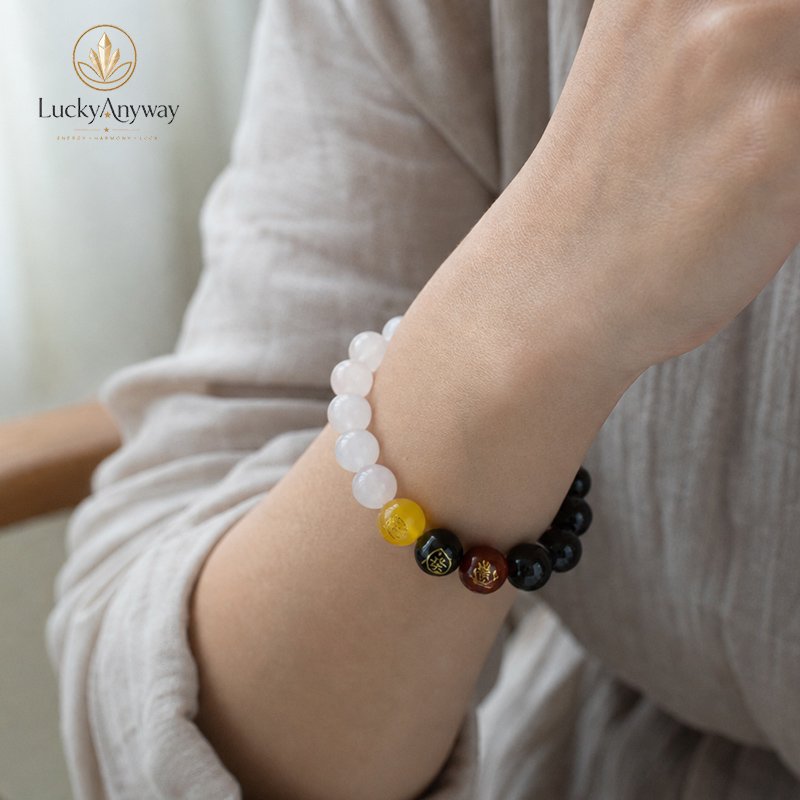
Once the traditional assessment has established the intended direction, the practitioner can consider materials commonly associated with the relevant elements. Green aventurine and green agate are often used in Wood-associated designs; red agate or garnet may be selected for Fire; citrine and tiger’s eye are common choices for Earth; clear quartz and white agate may be used for Metal; and black obsidian or black agate often appears in Water-associated designs.
These are conventional associations, not an automatic prescription. The exact choice depends on the design approach, the actual variety and appearance of the stone, and the role it is intended to play. Different practitioners may classify some materials differently, particularly when colour, pattern, and variety point in different directions.
The designer must also consider how the crystals work together visually and practically. A bracelet made from several stone varieties should still feel coherent on the wrist. Bead size, colour transitions, surface finish, and the proportion of each material affect the finished piece. A thoughtful custom crystal bracelet balances the traditional rationale with the realities of jewellery design.
At LuckyAnyway, the purpose of a personalized Five Element bracelet is to connect traditional principles with a considered arrangement of wearable materials. The objective is not to make every bracelet contain equal amounts of all five elements, but to give the selected combination a clear reason for being there.
Why might a personalized bracelet use more of one element than another?
A personalized Five Element bracelet does not need equal numbers of Wood, Fire, Earth, Metal, and Water beads. Equal quantities can create a visually symmetrical design, but visual symmetry and traditional suitability are two different considerations. When the bracelet is designed around a BaZi assessment, the arrangement should reflect the reasoning behind that assessment rather than follow a fixed rule about how many beads each element must receive.
For example, a general-purpose bracelet might use one colour for each element to make the Five Element concept immediately recognizable. A personalized design may instead use a greater proportion of one material, a smaller supporting accent, or a more restrained combination. The choice depends on the intended arrangement, the classification system used, and the practical requirements of the finished jewellery.
There is an important distinction here: emphasizing an element in a bracelet does not mean that the wearer should simply maximize that element in every area of life. In BaZi, an element’s role depends on its relationship with the complete chart. The generating and controlling cycles explain why an element cannot be judged in isolation. Wood generates Fire, Fire generates Earth, Earth generates Metal, Metal generates Water, and Water generates Wood. Each element also participates in a controlling relationship with another.
A thoughtful designer considers these relationships before translating the assessment into materials. The aim is a coherent traditional arrangement, not a contest to include as many beads of a supposedly favourable element as possible.
The practical design still matters
Even when one element has a greater role in the design, the bracelet should remain wearable. Too many contrasting materials can make the finished piece look disjointed; a single dominant colour may be more suitable for someone who prefers understated jewellery. Bead diameter, wrist size, surface finish, and the arrangement of accent beads should all be considered alongside the traditional intention.
When discussing a custom order, tell the maker whether you prefer a subtle everyday bracelet or a more distinctive piece. This does not replace BaZi analysis, but it helps the designer translate the traditional recommendation into jewellery you will actually enjoy wearing.
How is a personalized BaZi bracelet different from a general Five Element bracelet?
A general Five Element bracelet usually represents the five categories through a combination of colours and stones. It may be suitable for someone who appreciates Chinese metaphysical culture and wants a bracelet that expresses the traditional idea of the Five Elements. Its design may be based on a standard colour scheme or a broadly defined intention.
A personalized BaZi bracelet begins with a different question: what does this individual’s complete chart indicate? The practitioner interprets the chart, identifies the relevant relationships, and then considers which traditional material associations fit the intended design. The resulting bracelet may look quite different from a standard five-colour piece, because its composition follows a particular rationale.
| Comparison | General Five Element Bracelet | Personalized BaZi Bracelet | What the Buyer Should Expect | Question to Ask |
|---|---|---|---|---|
| Starting point | A general Five Element concept or colour scheme | The individual’s complete BaZi chart | A clear distinction between standard and personalized design | Is this design based on my chart? |
| Material selection | Usually follows established material or colour associations | Uses associations in light of the chart’s interpretation | A reason for the selected stones | Why were these particular materials chosen? |
| Element distribution | May aim for a balanced visual representation of all five | May emphasize selected elements or relationships | An arrangement with a defined purpose | Does every element need equal representation? |
| Personal information | May require no birth details | Typically requires accurate birth information | Clarity about what information is needed | Which birth details are required? |
| Best fit | People seeking a general cultural or decorative design | People seeking an arrangement informed by personal BaZi interpretation | A choice that matches the buyer’s actual intention | Am I looking for a general design or personal guidance? |
Neither category needs to be disguised as the other. A general bracelet can be attractive and meaningful without being based on an individual chart. A personalized bracelet should be accompanied by an explanation of the assessment behind it. Clear communication allows buyers to decide which type is worth purchasing for their needs.
For more about the approach behind the products and the traditions that inform them, visit About LuckyAnyway.
What mistakes should you avoid when ordering a custom crystal bracelet?
The most common mistake is treating one piece of information as a complete reading. A birth-year animal, a single Day Master label, or a chart showing that one element is absent may be useful starting information, but none of these alone establishes which crystals are appropriate for a personalized design.
Another mistake is choosing a bracelet by colour first and asking for a traditional explanation afterwards. If you strongly prefer black stones, for instance, that preference can help guide the appearance of the final piece. It should not automatically determine that Water is the element your chart needs. A good design process keeps personal style and traditional judgment distinct, then finds a practical way to bring them together.
It is also worth checking the product description carefully. Terms such as “natural crystal,” “custom,” and “BaZi-based” describe different things. Natural refers to the material and its treatment status; custom indicates that the product is made or adjusted to order; BaZi-based should mean that the selection is informed by an interpretation of the person’s chart. One label does not automatically establish the other two.
Before paying for a custom Five Element bracelet, clarify these points with the seller:
- Whether the design is based on a complete BaZi chart or a general element category.
- Which crystals and varieties are being used, including any disclosed treatments.
- Why the selected materials suit the intended traditional arrangement.
- Whether bead size, wrist measurement, and preferred style can be accommodated.
- What information is required before the maker can confirm the design.
These questions make the buying process more useful for both sides. They also help prevent the disappointment of receiving a bracelet that looks appealing but does not match the personalization the customer thought they had ordered.
Frequently asked questions about personalized Five Element crystals
Can I order a personalized Five Element bracelet using only my birth date?
A birth date provides important information, but a complete BaZi chart generally uses the year, month, day, and hour of birth. The accuracy of the birth time can matter to the chart calculation. If the hour is unknown, tell the practitioner rather than guessing. They can explain what can still be assessed and which parts of the interpretation remain uncertain.
Does a personalized crystal bracelet need to contain all five elements?
Not necessarily. A design can represent all five elements, but a personalized arrangement may emphasize particular materials according to the traditional assessment. Equal quantities are not a universal requirement. What matters is whether the composition follows a clear rationale and whether the maker explains the approach being used.
Can I request specific crystals for a BaZi bracelet?
Yes. You can explain which stones you like, which colours you prefer, and whether you need a discreet design for everyday wear. The designer can then consider how those preferences fit the intended arrangement. If a requested stone does not suit the traditional plan, ask whether another variety or a different bead arrangement would be more appropriate.
Where should I start if I want a personalized Five Element bracelet?
Start by deciding whether you want a general Five Element design or a bracelet informed by your personal BaZi chart. If personal interpretation is important to you, gather your accurate birth information and discuss the intended design before ordering. You can use the LuckyAnyway Contact page to ask about the process and clarify the details needed for your request.
Choose the reasoning before choosing the stones
A personalized Five Element bracelet begins with a traditional assessment, not a handful of colour labels. Seasonal climate, root support, chart structure, strength, and the chart’s main imbalance each contribute to the judgment. The crystals are selected afterwards, using their traditional associations to create a coherent design that can also be worn comfortably.
If you are comparing custom crystal bracelets, look for a clear distinction between general recommendations and designs based on personal BaZi interpretation. Ask why the materials were chosen, how the complete chart was considered, and whether your practical preferences can be incorporated. Those answers tell you far more about the design process than a promise to include all five colours.
At LuckyAnyway, Five Element jewellery brings traditional Chinese thought into a personal, wearable form. The aim is to make the relationship between the chart, the material choices, and the finished bracelet understandable. With a clear intention and careful selection, a bracelet can serve as a meaningful reminder to act with greater awareness, follow a considered direction, and approach life’s changes in the spirit of traditional Chinese wisdom.