What Crystals Are Used in Five Element Bracelets?
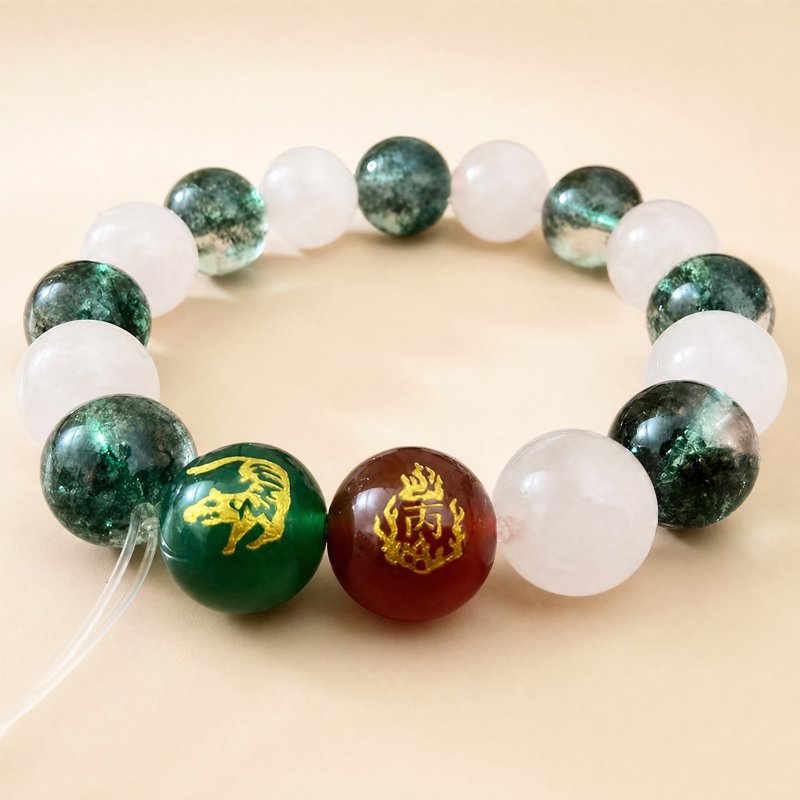
Five Element Bracelets commonly use natural crystals and gemstones such as clear quartz, amethyst, rose quartz, citrine, tiger’s eye, black obsidian, aventurine, and various forms of agate. In traditional Chinese Five Element practice, these materials are associated with Wood, Fire, Earth, Metal, or Water through their colour, appearance, natural qualities, and symbolic correspondence. The selection is not simply a matter of matching five colours. A thoughtfully designed bracelet considers how the materials work together and, when personalized, how their traditional associations relate to the wearer’s BaZi structure.
That distinction matters. Two bracelets may contain attractive crystals representing all five elements, yet their arrangements and intended purposes can be quite different. The materials should be selected with a clear traditional principle in mind, rather than assembled merely to make a colourful piece of jewellery.
Which crystals are commonly used in Five Element Bracelets?
The crystals most often found in Five Element crystal jewelry include quartz, agate, obsidian, aventurine, tiger’s eye, and other natural gemstones. Each has its own appearance and traditional associations. Some are selected because their colour corresponds naturally with an element; others are chosen for their material character and place within a particular design.
The following table gives a practical overview of commonly used materials. These are traditional design associations, not a universal classification that every practitioner must follow. The actual choice depends on the purpose of the bracelet and the principles used by the maker.
| Element | Common Crystals | Typical Appearance | Traditional Association | Selection Consideration |
|---|---|---|---|---|
| Wood | Green aventurine, green agate, moss agate | Green tones, natural patterns, organic appearance | Growth, development, renewal | Consider the role of Wood in the overall Five Element arrangement. |
| Fire | Amethyst, red agate, garnet, rose quartz | Red, purple, pink, and warm tones | Brightness, expression, vitality | Distinguish warm colour correspondence from the actual purpose of the design. |
| Earth | Citrine, yellow agate, tiger’s eye | Yellow, golden, brown, and earthy tones | Stability, nourishment, support | Assess whether Earth supports the intended arrangement or creates excess. |
| Metal | White quartz, clear quartz, white agate | White, silver-toned, transparent, or pale colours | Clarity, structure, discipline | Do not assume every white stone is suitable simply because it looks like Metal. |
| Water | Black obsidian, black agate, smoky quartz, lapis lazuli | Black, deep blue, dark grey, and smoky tones | Wisdom, depth, adaptability | Consider the full chart rather than choosing dark stones by appearance alone. |
A point worth remembering: these associations are useful for understanding traditional bracelet design, but they should not be treated as an inflexible mineral dictionary. Different schools and practitioners may classify certain stones differently. A responsible maker should be able to explain the reasoning behind the material choices instead of presenting one colour chart as the only accepted method.
How are crystals associated with the Five Elements?
The traditional Five Elements system describes relationships among Wood, Fire, Earth, Metal, and Water. It is not merely a classification of five colours. Each element has its own nature, movement, and relationship with the others. In a crystal bracelet, colour is often the most visible starting point, but a more considered design also looks at the stone’s appearance, traditional symbolism, and role in the complete arrangement.
For example, green is commonly associated with Wood, red with Fire, yellow with Earth, white with Metal, and black or deep blue with Water. This gives consumers a useful first understanding of five element crystals. However, colour correspondence is only one layer of traditional selection.
The five colours are a starting point, not the whole method
A common online approach is to divide crystals into five groups by colour and then place one bead from each group into a bracelet. The result may look balanced, but the appearance of five colours does not automatically mean the design is suitable for a particular person.
Traditional Five Element reasoning also considers the generating and controlling relationships:
- Wood generates Fire.
- Fire generates Earth.
- Earth generates Metal.
- Metal generates Water.
- Water generates Wood.
The controlling relationships are equally important: Wood controls Earth, Earth controls Water, Water controls Fire, Fire controls Metal, and Metal controls Wood. These relationships help explain why an arrangement should be considered as a whole. Adding a material associated with an element is not always beneficial simply because that element appears less frequently in a birth chart.
This is where the difference between a decorative five-element crystal bracelet and a personalized Five Element bracelet becomes apparent. The former may aim for visual representation of all five elements. The latter should have a defined traditional purpose and a reason for including each material.
Does a crystal’s colour determine its Five Element association?
Colour is an important traditional reference, but it should not be the sole basis for deciding a crystal’s element. A stone’s colour may make its correspondence easy to recognize, yet the classification of natural materials can involve more than appearance. The same gemstone family may also have different varieties, shades, patterns, and treatments.
Take quartz as an example. Clear quartz is often used in designs associated with Metal because of its clear or white appearance. Smoky quartz, however, is frequently placed in darker-toned designs associated with Water or Earth, depending on the classification approach. Treating every quartz variety as having exactly the same correspondence would overlook an important distinction in material selection.
The following comparison shows why a buyer should ask about the actual variety rather than relying on a broad gemstone name.
| Crystal Family | Variety | Visible Character | Common Design Association | What Buyers Should Check |
|---|---|---|---|---|
| Quartz | Clear quartz | Transparent or colourless | Often associated with Metal | Confirm the material and its intended role in the bracelet. |
| Quartz | Smoky quartz | Brown, grey, smoky transparency | Often associated with darker Earth or Water designs | Ask which traditional classification the maker follows. |
| Agate | Green agate | Green bands or solid green tones | Commonly associated with Wood | Check the actual colour and whether it is natural or treated. |
| Agate | Red agate | Red, orange-red, or reddish brown | Commonly associated with Fire | Do not confuse a visual match with a personalized recommendation. |
For this reason, when comparing a natural crystal bracelet with a mass-produced gemstone bracelet, ask the seller to identify the actual stone variety. A description such as “quartz” or “agate” may be too broad to explain why that particular bead was selected.
Why is choosing five different crystals not enough?
A bracelet containing Wood, Fire, Earth, Metal, and Water materials may represent the Five Elements visually, but a complete arrangement requires more than equal representation. In traditional practice, the relationship among elements matters. A person’s chart may already contain a strong or excessive element, while another element may be needed to regulate the overall structure. Adding one bead from every category does not resolve that question.
This is one of the most frequent mistakes I see in simplified online recommendations. People are told to find a bracelet containing all five elements, or to buy a particular colour because their birth date supposedly lacks that element. The recommendation is easy to follow, but the underlying judgment may be incomplete.
At LuckyAnyway, the intention behind a Five Element bracelet is to connect traditional principles with the selection of wearable materials. The design should have a reason for its composition, rather than relying on the assumption that more colours automatically create better balance. You can also learn about the philosophy and approach behind the brand through the About LuckyAnyway page.
How does BaZi influence the choice of crystals?
When a Five Element crystal bracelet is intended for personal use rather than decoration alone, BaZi provides a more meaningful basis for selecting its materials. A person’s birth chart is formed by the Heavenly Stems and Earthly Branches of the year, month, day, and hour of birth. These components reveal the distribution and interaction of the Five Elements, but the interpretation requires more than counting how many times each element appears.
An experienced practitioner does not immediately look for the element that appears least often. The first task is to understand the chart’s actual condition. Is the season cold or hot? Is the Day Master supported by roots? What structure has formed? Is the chart excessively strong, weak, dry, cold, or damp? These questions influence which elements may be useful and how they should be applied.
In classical Zi Ping practice, works such as Di Tian Sui, Qiong Tong Bao Jian, San Ming Tong Hui, and Zi Ping Zhen Quan offer different layers of interpretation. Seasonal climate, root support, chart structure, strength, and the relationship between useful and unfavourable elements all deserve attention. This is why two people born in the same zodiac year, or even on dates with similar element distributions, may require different bracelet designs.
A practical example: the element that is missing may not be the element to add
Imagine two people whose charts contain relatively little Water. A simplified online calculator may recommend black crystals to both. However, their chart conditions may be entirely different. One person may have a dry and hot chart in which Water has an important regulating role. The other may have a cold and damp chart in which adding more Water could make the overall condition less favourable.
The visible absence is similar, but the traditional judgment is not. This distinction is especially important when choosing black obsidian, black agate, or other dark stones for a Water-associated design. A material should not be selected simply because its colour corresponds to an element that appears scarce.
| BaZi Consideration | What Is Examined | Why It Matters | Possible Design Implication | Common Mistake |
|---|---|---|---|---|
| Seasonal climate (调候) | Whether the chart is excessively hot, cold, dry, or damp | Climate can influence the first stage of traditional assessment. | The choice may favour materials associated with the element needed for regulation. | Judging only by element counts. |
| Root support (通根) | Whether the Day Master has support in the Earthly Branches | Visible stems alone do not reveal the full strength of an element. | The design should reflect the chart’s underlying support and relationships. | Assuming a visible element is automatically strong. |
| Chart structure (格局) | The structure formed through the month command and the chart’s interactions | Different structures require different interpretations. | The material combination should follow the chart’s actual structure. | Using the Day Master alone to select crystals. |
| Strength and weakness (旺衰) | The overall strength of the Day Master and its support or restraint | An element’s usefulness depends on the complete chart. | The balance of materials should not be determined by a generic formula. | Assuming every strong Day Master needs the same elements. |
| Useful element and remedy (病药) | The chart’s main imbalance and the element or relationship that addresses it | The remedy should address the actual problem, not an assumed deficiency. | The primary material choice should have a clear traditional purpose. | Buying the element that appears least frequently. |
This is why a personalized bracelet should begin with a proper reading of the chart. LuckyAnyway’s BaZi Analysis service provides a starting point for understanding the personal Five Element structure before choosing a suitable combination of crystals.
Should you choose crystals according to your Day Master?
The Day Master is important in BaZi, but it is not a complete purchasing instruction. It represents the person within the chart and provides the starting point for understanding the relationships among the other elements. It does not mean that everyone with a Wood Day Master should wear green aventurine, or that everyone with a Metal Day Master should choose white quartz.
Consider two people with a Jia Wood Day Master. One may be born in a season where Wood is already strong, with substantial root support. Another may have a weaker Wood Day Master that lacks support. Their needs may differ considerably. Even within the same Day Master, seasonal conditions, combinations, clashes, and the complete chart can change the judgment.
The same caution applies to the other four Day Masters. A Fire Day Master does not automatically need Water; an Earth Day Master does not automatically need Wood; a Metal Day Master does not automatically benefit from more Earth. Traditional selection must consider the whole pattern rather than assigning a fixed crystal to each Day Master.
For buyers, this gives a simple question to ask a seller: “Is this bracelet designed according to my complete BaZi chart, or is it a general bracelet for my Day Master?” The difference is substantial. A general design can still be attractive and meaningful, but it should not be presented as a fully personalized arrangement.
How can you tell whether a Five Element crystal bracelet is well designed?
A well-designed Five Element crystal bracelet should make sense in three areas: the material, the traditional reasoning, and the finished construction. A bracelet may contain beautiful natural gemstones, but attractive beads alone do not explain why the combination was chosen. Equally, a convincing traditional explanation is not enough if the actual materials are poorly identified or the workmanship is careless.
Before placing an order, look beyond the product photograph. Ask how the stones were selected, whether the design is general or personalized, and whether the seller can explain the role of the main materials. These questions help separate a considered Chinese crystal bracelet from a product assembled mainly for visual appeal.
What to check before buying
- Crystal identification: Ask for the specific stone names rather than accepting broad descriptions such as “natural gemstone” or “five element stone”.
- Natural appearance: Check whether the seller explains natural colour variations, inclusions, treatments, and any dyed or enhanced materials.
- Traditional reasoning: Find out why each material belongs in the design and how the Five Element relationships were considered.
- Personalization: If the bracelet is advertised as BaZi-based, ask whether the full birth information is considered rather than only the birth year or Day Master.
- Bead quality and construction: Examine bead consistency, surface finish, drilling, stringing, and the overall comfort of the bracelet.
There is also a practical matter that buyers sometimes overlook: the bracelet must be suitable for regular wear. Bead size, wrist measurement, weight, and the arrangement of different materials affect comfort. A traditional design should still be a piece of jewellery that the wearer is happy to put on.
What is the difference between a general Five Element bracelet and a personalized one?
A general Five Element crystal bracelet is usually designed around a broad representation of the five categories. It may use a combination of green, red, yellow, white, and black stones to create a visually balanced arrangement. This type of crystal bead bracelet can be suitable for someone who appreciates the traditional Five Element concept and wants a wearable expression of it.
A personalized bracelet takes a different approach. Its material selection is guided by an individual’s BaZi interpretation. The designer considers which elements are useful, which relationships need attention, and how the selected stones can represent that intended arrangement. Some designs may include several materials associated with one element while using fewer beads from another. Equal quantities are not a requirement.
For example, a bracelet designed for one person may place greater emphasis on Water-associated materials, while another may need a different combination involving Wood or Metal. The purpose is not to make every bracelet look identical, but to give each arrangement a clear reason for its composition.
If you are considering a personalized design, explore the LuckyAnyway Contact page to discuss your requirements before ordering. Providing accurate birth information and explaining your preferences will help establish whether a general or personalized arrangement is more appropriate.
Frequently asked questions about crystals used in Five Element Bracelets
Can one crystal represent more than one Five Element association?
Yes. Different practitioners may classify a material differently depending on its colour, variety, and traditional approach. Smoky quartz is a useful example because its darker brown or grey appearance may lead to different associations in different design systems. Rather than relying on a single universal label, ask the maker to explain the classification used and how the stone functions within the bracelet.
Do all Five Element Bracelets need five different types of crystals?
No. A bracelet does not need exactly five crystal types or equal quantities of five colours to follow a considered Five Element design. A general bracelet may represent all five elements visually, while a personalized arrangement may emphasize selected elements according to the wearer’s BaZi interpretation. The purpose of the design should determine the materials, not an arbitrary requirement to include one stone from every category.
Are natural crystals better than dyed or treated stones?
For buyers who value natural crystal materials, clear disclosure is important. Natural stones often have variations in colour, inclusions, and patterns, while some commercial beads may be dyed, heated, coated, or otherwise enhanced. The appropriate choice depends on the product’s purpose and the buyer’s preference, but the seller should identify treatments honestly. Do not assume that a vivid colour automatically indicates a higher-quality natural stone.
Can I choose a Five Element crystal bracelet based on my birth year?
Your birth year can provide part of the traditional information, but it is not sufficient for a complete BaZi-based selection. A proper chart requires the year, month, day, and hour of birth. The Day Master, seasonal climate, root support, chart structure, and useful elements must be considered together. A bracelet selected only from the zodiac animal or birth-year element is a general recommendation, not a full personal assessment.
Choose the crystals with a clear traditional purpose
The crystals used in Five Element Bracelets are not simply five colours placed together. Green aventurine, red agate, citrine, clear quartz, black obsidian, and many other natural materials each bring their own appearance and traditional associations to a design. Understanding those associations is a useful first step, but the real distinction lies in how the materials are selected and combined.
If you are choosing a bracelet for its cultural meaning and personal significance, begin by deciding whether you want a general Five Element design or a bracelet informed by your BaZi chart. If you want a more personal arrangement, do not rely solely on a birth-year label, a Day Master chart, or an online calculation of missing elements. Ask how the recommendation was reached and whether the complete chart has been considered.
At LuckyAnyway, the aim is to bring traditional Chinese Five Element principles into carefully considered crystal jewellery. A bracelet should have a reason behind its materials, a coherent design, and a purpose that the wearer understands. When traditional judgment and thoughtful craftsmanship come together, a Five Element crystal bracelet becomes more than a collection of attractive beads: it becomes a personal expression of traditional wisdom and the intention to move through life with greater awareness and direction.