
Why a Personalized BaZi Bracelet Is Different From a Generic Five Element Bracelet
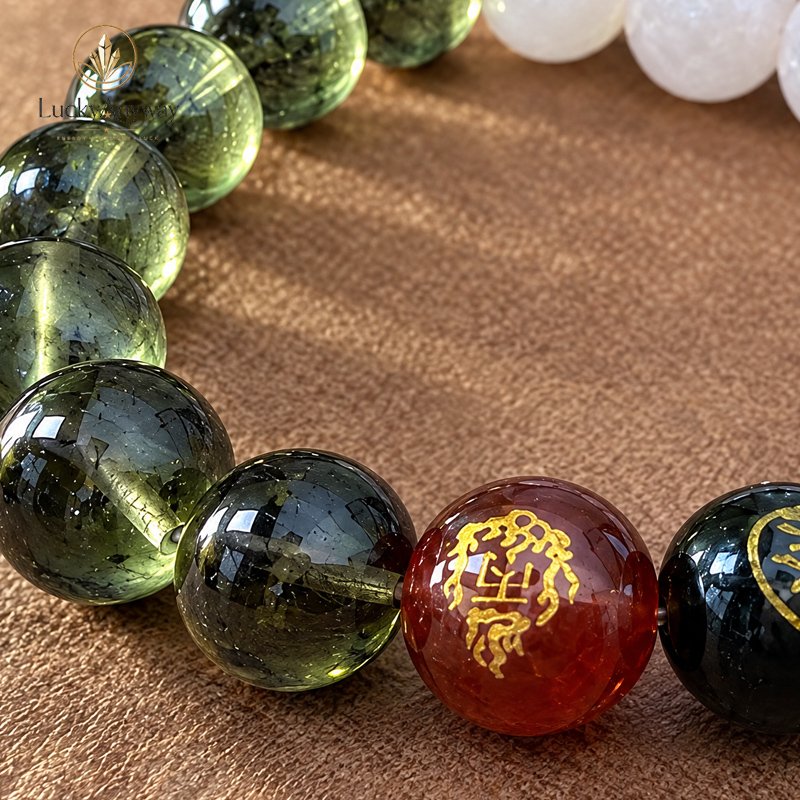
A personalized BaZi bracelet differs from a generic Five Element bracelet because its material selection should follow an individual’s BaZi chart, rather than a standard formula applied to everyone. Traditional analysis considers the year, month, day, and hour pillars, seasonal conditions, the Day Master’s roots, chart structure, strength and weakness, and the chart’s specific needs. A generic bracelet may use familiar Five Element colors or crystal associations, while a personalized five element bracelet requires a reasoned explanation of why its particular combination suits the person. The real difference is not simply the number of custom details; it is the traditional judgment behind the finished design.
What makes a personalized BaZi bracelet genuinely different?
The difference begins before a crystal is selected. A generic Five Element bracelet usually starts with a general association: a color linked to an element, a zodiac sign, a birth year, or an online calculation. That approach can be suitable for a general cultural product, but it does not establish what an individual BaZi chart calls for.
A personalized BaZi bracelet should begin with a chart and a clear line of reasoning. The practitioner examines how the pillars relate to one another, what role the Day Master plays, and which conditions deserve attention. Only then can the interpretation guide a proposed combination of materials and elemental qualities.
This distinction matters because two people who share a Day Master may not share the same chart structure. Their birth months, roots, combinations, clashes, and seasonal conditions can differ. A recommendation that suits one chart cannot automatically be transferred to another simply because both people have the same Day Master or zodiac animal.
There is also a difference between customization of appearance and customization of selection. Adding a name, engraving a birth year, or letting a buyer choose bead colors personalizes the item’s appearance. Those features may be valuable, but they do not demonstrate that the Five Element composition was selected through BaZi analysis.
When evaluating a Bazi crystal bracelet, ask one direct question: What part of the traditional chart interpretation led to these materials being chosen? A knowledgeable seller should be able to explain the connection in accessible language. The explanation need not disclose every technical detail, but it should go beyond saying that a certain color is good for everyone born in a particular year.
What should happen before the crystals are chosen?
A sound custom process starts with accurate birth information. Traditional BaZi uses four pillars derived from the year, month, day, and hour of birth. If the birth time is unknown, that uncertainty should be acknowledged rather than quietly ignored. A preliminary interpretation may still be possible, but it should not be presented as identical to a complete chart reading.
After the chart is established, the practitioner needs to interpret it in context. This is where a genuine traditional framework differs from a simple calculator. The visible number of elements is not enough; the same element can have different roles depending on the season, its roots, the chart’s structure, and its relationships with the other elements.
In a careful Zi Ping approach, several judgments work together:
- Seasonal adjustment (调候): Consider whether cold, heat, dryness, or moisture needs attention. This is not the same as judging whether the Day Master is strong or weak.
- Roots (通根): Examine whether an element has support in the Earthly Branches, rather than relying only on its visible appearances.
- Chart structure (格局): Identify how the chart’s principal relationships operate instead of applying one rule to every chart with the same Day Master.
- Strength and weakness (旺衰): Assess the Day Master within the complete chart, taking seasonal conditions and roots into account.
- Imbalance and response (病药): Identify the chart’s particular issue and the traditional adjustment that may address it, rather than automatically adding the least visible element.
These are not separate boxes to tick mechanically. The judgments inform one another, and their importance depends on the chart. A practitioner who starts with a fixed crystal recipe before examining these relationships has effectively decided the answer before doing the analysis.
For buyers, this gives you a useful way to assess the process. You do not need to perform the BaZi reading yourself. You do need to know whether the recommendation came from a meaningful interpretation or from a generic rule dressed up as personalization.
Why can the same Day Master lead to different bracelet recommendations?
The Day Master is an important reference in BaZi, but it is not a complete prescription for what to wear. Its role depends on the rest of the chart. The month branch provides seasonal context, roots affect the support available to an element, and the chart’s structure shapes how the relationships operate. A label such as “Wood Day Master” or “Metal Day Master” cannot settle the choice by itself.
Take Metal as an example. It would be careless to assume that every Metal Day Master should wear more Earth because Earth is traditionally associated with generating Metal. Whether that relationship is appropriate depends on the complete chart. Seasonal dryness, the condition of the roots, the surrounding elements, and the structure may change the interpretation. A general rule can sound convincing while missing the most important issue in a particular chart.
The same caution applies to Water, Wood, Fire, and Earth. An element may be useful in one chart and require restraint in another. The task is not to make the bracelet contain more of the element associated with the Day Master. It is to understand the chart first, then decide which traditional associations should guide the design.
This is why a personalized five element bracelet should not be marketed as a universal formula for a birth element. A real individualized recommendation must allow for differences between charts, even when the people involved share a zodiac sign, birth year, or Day Master.
| Selection stage | Generic approach | Personalized BaZi approach | What the buyer should ask | Why it matters |
|---|---|---|---|---|
| Starting information | Zodiac, birth year, or a general element label | Birth details used to establish the four pillars | What information was used? | The quality of the starting information affects the reading |
| Elemental judgment | Color matching or element counting | Season, roots, structure, strength, and specific imbalance | How was the proposed direction determined? | An element’s role matters more than its simple count |
| Material choice | A fixed crystal combination for a broad group | Materials chosen to reflect the interpretation | Why were these materials combined? | The design should follow the reasoning |
| Personalization | Name engraving or selectable colors | Individual chart interpretation informing the composition | What part is customized beyond appearance? | Personalized appearance and personalized selection are different |
| Explanation | A broad statement about luck or an element | A reasoned explanation linked to the individual chart | Can the recommendation be explained clearly? | Clear reasoning makes the service easier to assess |
If you want to understand how a personal chart can be interpreted before choosing materials, LuckyAnyway’s BaZi Analysis service is a relevant starting point. Understanding the chart first makes the later design discussion more meaningful.
How does BaZi analysis translate into a real crystal combination?
Once the chart has been interpreted, the next step is to turn the traditional judgment into a wearable design. This is where the quality of a custom five element bracelet becomes visible. The material combination should follow the intended selection rather than being decided by whichever crystals happen to be available or popular.
In traditional Five Element associations, green tones are commonly connected with Wood, red with Fire, yellow and earthy tones with Earth, white with Metal, and black or dark tones with Water. These associations can guide the choice of crystal colors and materials. However, they are the beginning of the design discussion, not a substitute for BaZi interpretation.
Suppose a chart interpretation indicates that a particular elemental relationship deserves attention. The designer may consider a main material associated with that element, then decide whether other materials should complement the arrangement. The final composition depends on the reasoning behind the selection, the qualities of the available stones, and the practical requirements of the bracelet. There is no universal requirement to use all five elements in equal quantities.
Be cautious when a product description presents a fixed recipe as suitable for everyone. A bracelet containing five colors may represent the Five Elements visually, but that does not automatically make it personalized. Equally, a design using only two or three materials may be more consistent with an individual selection if those materials have been chosen for a clear traditional reason.
Material quality and design also deserve attention. Confirm the bead size, wrist measurement, finish, natural variation in the stones, and any care requirements. These practical details do not replace the metaphysical reasoning; they determine whether the intended combination becomes a well-made bracelet that you can wear comfortably.
At LuckyAnyway, the purpose of a personalized crystal bracelet is to connect traditional interpretation with a considered material selection. The buyer should be able to understand the general reasoning behind the combination, rather than receiving a list of crystal names without an explanation of why they belong together.
How can you tell whether a bracelet is personalized or merely labeled as custom?
The word “custom” is used in different ways. One seller may allow you to choose the color and size, another may engrave a name, and another may select materials after reviewing your BaZi chart. These services can all involve customization, but they do not offer the same depth of individual selection.
Before paying for a personalized BaZi bracelet, find out which part of the process is actually tailored to you. If the seller asks only for your zodiac sign and immediately provides the same combination sold to everyone with that sign, the service is not equivalent to a full chart-based recommendation. If the seller collects birth details but cannot explain how they affect the choice, you should ask for clarification before proceeding.
A useful way to judge the service is to look for a clear connection between three things: the birth information, the traditional interpretation, and the final material combination. The explanation does not need to be excessively technical, but those stages should fit together logically.
| Customization claim | What may actually be customized | What to verify | A useful follow-up question | What it tells you |
|---|---|---|---|---|
| Custom size | Wrist fit or bead dimensions | Whether the elemental design changes | Is this a fit adjustment or a chart-based selection? | Separates practical customization from metaphysical personalization |
| Custom color | Appearance and preferred palette | Whether the color choice follows a traditional interpretation | Why is this color appropriate for my selection? | Shows whether color preference is being confused with chart analysis |
| Birth-year personalization | Zodiac motif or year-based association | Whether the full BaZi chart was considered | Is the recommendation based on my year pillar alone? | Clarifies the level of interpretation offered |
| BaZi-based selection | Materials selected after chart interpretation | The reasoning connecting the chart to the combination | Which chart factors influenced the material choice? | Helps establish whether the personalization has a clear basis |
| Fully bespoke design | Both the selection process and the finished arrangement | How the analysis, materials, and final design relate | Can you explain the selection before production? | Makes the service and its deliverables easier to evaluate |
A custom feng shui bracelet may also be described as personalized, but that phrase can refer to different approaches. Some products are designed around broad Feng Shui associations, while others use individual BaZi information to guide their composition. Feng Shui and BaZi are related traditional disciplines, but they are not interchangeable. Ask which approach the seller actually uses rather than assuming that every personalized Feng Shui bracelet includes a full BaZi reading.
What should you prepare before ordering a personalized BaZi bracelet?
You do not need to arrive with your own conclusions about which element is favorable. That is precisely the judgment the traditional analysis is meant to help establish. Your role as the buyer is to provide accurate information, explain your preferences, and make sure you understand how the proposed product is selected.
- Provide your birth date and exact birth time if available. If the time is approximate or unknown, say so clearly.
- Provide your birthplace when requested for chart calculation, particularly if time-zone or local-time conversion may matter.
- Ask whether the recommendation is based on the complete four-pillar chart or a more limited assessment.
- Discuss practical requirements, including wrist size, bead size, preferred style, and any materials you prefer to avoid.
- Ask for a plain-language explanation of why the proposed materials were chosen and how they relate to the interpretation.
It is also worth confirming what the order includes. Will you receive a chart interpretation, a material recommendation, a finished bracelet, or some combination of these? Clarifying the deliverables before payment prevents misunderstandings and helps you compare services fairly.
If you are ready to explore available options, the LuckyAnyway Five Element Collection is the natural place to start. Compare the product details and the level of personalization offered, then ask for clarification if you need to understand how a particular selection is made.
Frequently Asked Questions
Is a personalized BaZi bracelet better than a generic Five Element bracelet?
It depends on what you want. A generic Five Element bracelet can be suitable if you prefer a broad traditional association, a particular color combination, or a general cultural design. A personalized BaZi bracelet is intended for buyers who want the material selection to follow their individual chart. Its value lies in the reasoning and interpretation behind the selection, not simply in the word “personalized” on the product page.
Does a personalized BaZi bracelet need to contain all five elements?
No universal rule requires every personalized bracelet to represent Wood, Fire, Earth, Metal, and Water in equal amounts. Traditional BaZi interpretation examines the roles and relationships of the elements in a particular chart. The final material combination should follow the selection rationale rather than a fixed requirement to include five colors or five kinds of crystal.
Can I choose a personalized crystal bracelet if I do not know my birth time?
You can still begin the discussion, but the missing birth time should be acknowledged. A reading based on incomplete birth information may not offer the same detail as one based on all four pillars. Ask the practitioner what can reasonably be assessed from the available information and how that affects the recommendation before deciding whether to proceed.
Choose the reasoning, not just the label
The difference between a generic Five Element bracelet and a personalized BaZi bracelet is ultimately the process behind the design. Generic products may offer a broad connection to traditional elemental associations. A genuinely individualized bracelet should have a clear basis in the person’s chart, with material choices that follow the interpretation rather than a fixed formula.
When comparing options, look beyond bead colors, engraving, and claims of customization. Ask what information was considered, how the chart was interpreted, and why the selected materials belong together. These questions help you distinguish an attractive general product from a selection built around your individual requirements.
At LuckyAnyway, traditional BaZi and Five Element principles guide a more considered approach to personalized bracelet selection. Take the time to understand the process and choose an option whose explanation is as clear as its design. A meaningful custom piece should begin with sound traditional reasoning and carry that reasoning through to the finished bracelet.
Contact Us
Similar Posts
How to Choose a Five Element Bracelet?
Start With Your BaZi, Not the Bracelet To choose a Five Element Bracelet properly, begin with your BaZi rather than your zodiac sign, favorite color, or a simple list of missing elements. The Day Master provides the starting point, but it is only one part of the judgment. A practitioner should also consider the Month…
How Do the Five Elements Interact in BaZi? The Cycles of Generation and Control
Understanding Five Element Relationships in BaZi: How Generation and Control Shape a Chart In BaZi analysis, the Five Elements are not simply five categories that exist separately. They describe how different forces support, transform, restrict, and balance each other inside a person’s destiny structure. The generation cycle and control cycle are the basic movements behind…
What Crystals Are Used in Five Element Bracelets?
Five Element Bracelets commonly use natural crystals and gemstones such as clear quartz, amethyst, rose quartz, citrine, tiger’s eye, black obsidian, aventurine, and various forms of agate. In traditional Chinese Five Element practice, these materials are associated with Wood, Fire, Earth, Metal, or Water through their colour, appearance, natural qualities, and symbolic correspondence. The selection…
Can a Feng Shui Bracelet Help With Balance?
A Feng Shui bracelet can be used as a personal practice for balance by connecting traditional ideas of Qi, Yin and Yang, the Five Elements, auspicious symbolism, and personal intention. In Chinese tradition, however, balance does not mean making everything equal. It means finding a more suitable relationship between different forces, conditions, and environments. This…
Feng Shui Bracelets for Protection: What Do They Mean?
A Feng Shui protection bracelet is traditionally understood as a personal item that supports protection, harmony, and a balanced relationship between a person and their surrounding environment. In Chinese practice, protection is not only about avoiding negative influences but also about maintaining inner stability, strengthening positive connections, and creating a sense of alignment. A feng…
Why Your Zodiac Sign Is Not Enough to Choose a Five Element Bracelet
Your Chinese zodiac sign is not enough to determine which Five Element Bracelet is suitable for you. The zodiac sign comes from the year pillar of the traditional Chinese calendar, while BaZi analysis examines the year, month, day, and hour of birth and the relationships among all four pillars. Two people born under the same…